Why Europe’s settlement shift is really a collateral story — and how Comyno is addressing it, Comyno
Interview
Comyno
Why Europe’s settlement shift is really a collateral story — and how Comyno is addressing it
06 October 2026
T+1 is not the destination, say Comyno’s Frank Becker, chief operating officer, and Benjamin te Kaat, sales executive, who discuss why firms should view the upcoming settlement cycle as a catalyst to improve infrastructure and what they should be building towards
Image: stock.adobe.com/AddMeshCube
Europe’s move to T+1 settlement is now firmly on the agenda. With the transition targeted for October 2027, banks, brokers, custodians, and market infrastructures are beginning to assess what needs to change across their organisations.
Much of the industry conversation has understandably focused on settlement itself: settlement instructions, matching rates, standing settlement instructions (SSIs), affirmation processes, and the operational changes required to squeeze today’s post-trade activity into a much shorter window.
All of that matters. But it may also be missing the bigger picture.
The real challenge of T+1 is not simply how quickly a transaction can settle. It is how quickly institutions can understand their funding and collateral requirements, identify the right assets, mobilise them, and respond when circumstances change.
And that makes T+1 as much a collateral and liquidity challenge as a settlement one.
As Frank Becker, chief operating officer and head of sales at Comyno, puts it: “The industry naturally talks about T+1 as a settlement project, because settlement is where the deadline becomes visible. But if you look underneath, many of the real dependencies sit in collateral, liquidity, and data. Making the last step faster doesn’t help much if everything feeding into it still operates on yesterday’s timelines.”
Settlement is only the visible part of the problem
At first glance, shortening the settlement cycle looks relatively straightforward: if the industry currently settles a transaction two days after execution, it simply needs to perform the same processes one day earlier.
Unfortunately, markets do not work quite like that.
Compressing the settlement cycle means compressing everything that happens around settlement. Processes that previously had several operational windows available suddenly have considerably less room for error. This becomes particularly important for collateral.
Institutions will have less time to respond to margin calls, less time to perform collateral substitutions, and less time to arrange collateral upgrades. Treasury teams will have less time to fund unexpected positions, while collateral teams will need a much more accurate picture of which assets are actually available at any given moment.
In other words, T+1 does not just accelerate settlement. It accelerates decision making. And that is where things get interesting.
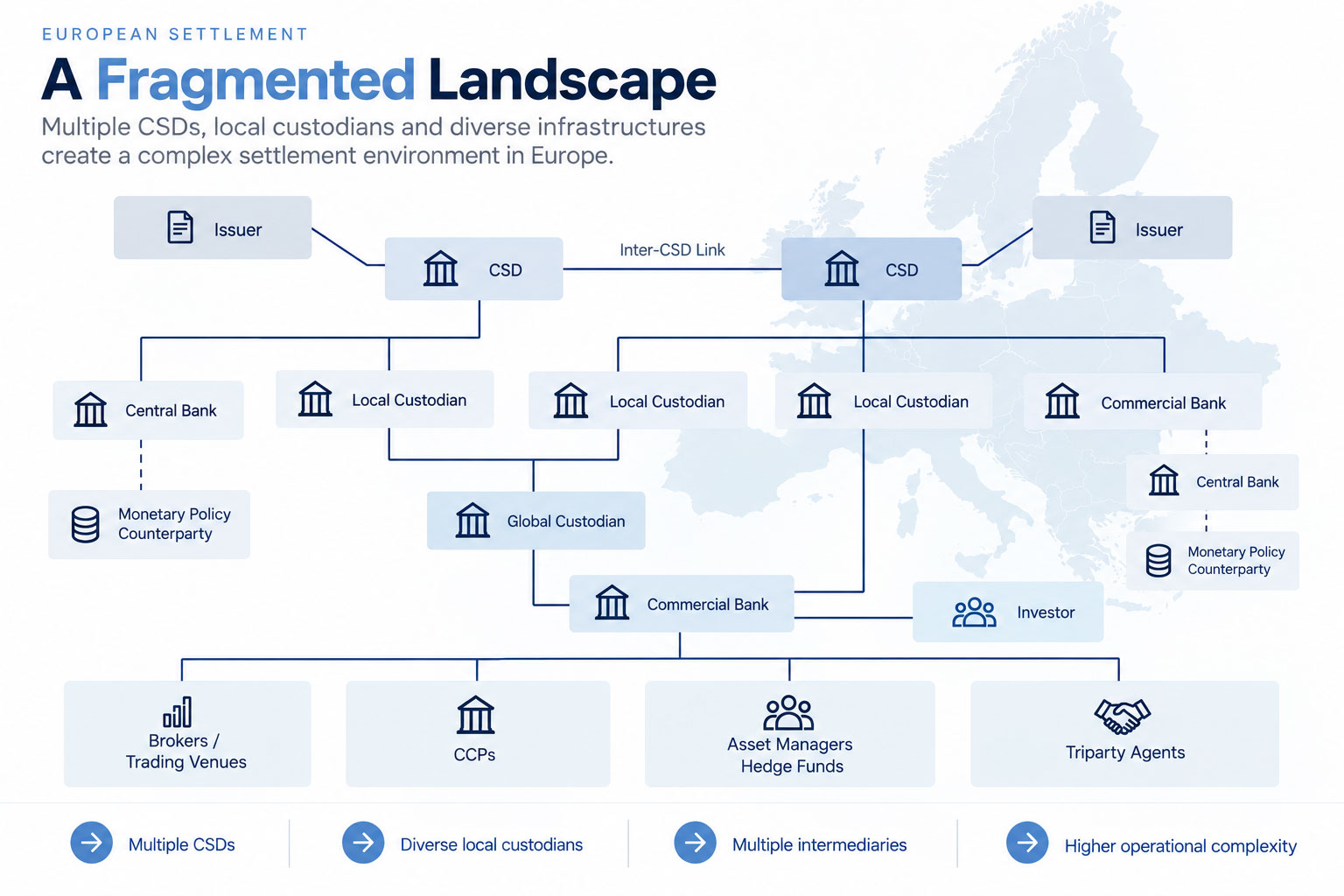
The European market also has characteristics that make the collateral question particularly important. European securities finance markets make extensive use of non-cash collateral and triparty structures. Collateral therefore moves through a complex network of custodians, agents, clearing infrastructures, and triparty providers.
Simply knowing that an institution owns €100 million of a particular security is not enough. The institution needs to know where those securities are held, whether they are already encumbered, whether they are eligible for a particular transaction, how quickly they can be mobilised, and whether using them represents the economically optimal decision.
That is a very different problem from simply sending a settlement instruction faster.
Benjamin te Kaat, sales executive at Comyno, says: “Clients rarely have a shortage of data. The problem is getting the right data, from the right systems, quickly enough to make a decision.
‘Under T+1, knowing that collateral exists somewhere in the organisation isn’t enough. You need to know whether you can actually use it — now.”
The collateral clock is getting faster
The traditional collateral operating model was designed around relatively predictable processing windows.
Collateral positions could be reconciled, margin calls calculated, eligibility checked, and assets allocated within defined operational cycles. Exceptions could often be resolved manually.
T+1 puts pressure on that model. When settlement cycles shorten, the tolerance for manual intervention becomes smaller.
An exception discovered late in the day can quickly turn into a funding requirement, failed settlement, or expensive borrowing requirement. This creates a growing need for intraday visibility.
A collateral manager should ideally be able to answer, in real time, some fairly basic questions: what collateral do I have? Where is it? What is available? What is eligible? What is already pledged? What will I need later today?
And what is the cheapest asset I can deliver without creating another problem somewhere else? Those questions sound simple. Getting the answers often is not.
The uncomfortable reality of collateral infrastructure
Many large financial institutions still operate fragmented collateral environments.
Different business units may maintain separate collateral pools. Securities lending, repo, derivatives, and treasury activities may use different systems. Assets may be held across multiple custodians and triparty agents. Eligibility rules may sit in different applications — or, in some cases, spreadsheets.
The result is that institutions can have substantial collateral inventories without necessarily having a consolidated view of what is genuinely available. There is also an organisational dimension.
Trading desks optimise transactions. Treasury manages liquidity and funding. Collateral teams manage eligibility and allocation.
Operations focuses on settlement and exceptions. Each function can be doing its job perfectly well while the organisation as a whole still makes a suboptimal collateral decision.
That might have been manageable when markets had more time. Under compressed settlement cycles, it becomes much harder.
“There is still a surprising amount of manual intervention in the market,” te Kaat observes. “Excel itself isn’t the enemy — we all use it. But if a spreadsheet, an email, and somebody’s personal knowledge are critical components of your collateral decision at 15:00, shortening the settlement cycle is going to expose that pretty quickly.”
There is no point automating a settlement instruction if someone still has to manually determine whether the collateral behind the transaction is eligible.
Figure 1
From collateral management to collateral optimisation
This is why the conversation needs to move beyond traditional collateral management. Banks increasingly need to think about collateral as an enterprise-wide resource. The first step is visibility: creating a consolidated view across collateral pools, custodians, trading books, and triparty relationships.
The second is eligibility. Eligibility rules should be machine-readable and capable of being evaluated automatically. Instead of an operator checking whether a particular ISIN satisfies a counterparty’s collateral schedule, an eligibility engine should be able to determine this immediately across potentially millions of positions.
The third step is optimisation. Once an institution knows what collateral it owns and where that collateral is eligible, the question becomes: what should it actually deliver? That means considering funding costs, haircuts, liquidity, asset scarcity, opportunity costs, and future obligations.
Cheapest-to-deliver is therefore becoming less of a nice-to-have optimisation exercise and more of a core part of the operating model.
Becker argues that this requires institutions to think beyond individual applications: “The objective shouldn’t be to buy another collateral tool and create another silo. The objective is to establish an operating model where inventory, eligibility, optimisation, trading, and settlement can work together. Technology should orchestrate that process rather than add another screen for somebody to monitor.”
This is where technology architecture becomes critical.
Rather than continuously adding standalone applications, firms increasingly need orchestration layers capable of connecting trading, inventory, collateral, treasury, and settlement processes. This is also the thinking behind Comyno’s C-One Suite, which brings securities finance workflows, data, and connectivity together across the transaction lifecycle, with capabilities spanning MultiMarket Manager for automated trading on multiple trading venues, Auto Returns, Auto Recalls, Locate Manager, and Collateral Optimiser, supported by Comyno’s Connectivity product for integration with the wider market infrastructure.
Connectivity is a strategic component of this architecture. A Collateral Optimiser may identify the most appropriate asset to deliver, but that decision has limited value if the surrounding infrastructure cannot communicate efficiently with custodians, triparty agents, trading venues, and internal systems.
In short, optimisation and execution cannot be treated as separate worlds. The best collateral decision is fairly useless if you cannot execute it quickly.
T+1 is probably not the final destination
There is another reason why firms should avoid designing their technology strategy exclusively around the October 2027 deadline. T+1 is unlikely to be the end state.
Across financial markets, the direction of travel is already visible: intraday collateral management, near real-time margining, intraday repo, tokenised assets, and new digital settlement networks. All of these developments point towards shorter processing cycles. The logical conclusion is T+0 — or, eventually, some form of instant or near-instant settlement.
That does not mean every market will suddenly move to instantaneous settlement. There are legitimate questions around liquidity, netting efficiency, and market structure that make immediate settlement far more complicated than simply making existing processes faster. But the trend is clear. Batch-based operating models are gradually being supplemented — and in some cases replaced — by event-driven ones.
For collateral management, that distinction is fundamental. In a traditional model, a firm may calculate its collateral requirements at defined times during the day and allocate assets accordingly. In an event-driven model, every trade, margin call, settlement instruction, or change in inventory potentially alters the optimal collateral allocation. The collateral system therefore needs to react continuously.
Te Kaat sees T+1 in that wider context: “If a bank invests heavily just to get over the October 2027 line, it may find itself having the same conversation again a few years later. T+1 should be used as an opportunity to ask what the operating model needs to look like in an intraday world. Otherwise, you’re basically renovating the kitchen when you know you’re going to rebuild the house.”
Intraday liquidity changes the equation
This has important implications for treasury. Under longer settlement cycles, institutions have historically had more time to identify funding gaps and source liquidity. As settlement windows compress, liquidity management increasingly becomes an intraday exercise.
A failed collateral movement at 10:00 may create a funding requirement shortly afterwards. A large securities lending recall may change available inventory. A margin call may suddenly consume securities that had been earmarked for another transaction.
The ability to identify these dependencies before they become problems will become increasingly valuable. This requires more than dashboards. It requires data models capable of combining positions, transactions, collateral requirements, eligibility rules, and settlement status in close to real time. And increasingly, it requires automated decision making.
Automation has to cover the entire lifecycle
Securities finance has already automated significant parts of its trading lifecycle.
Electronic trading, automated matching, and rule-based execution have become increasingly common. Locate workflows provide a good example.
What historically involved emails, phone calls, and manual inventory checks can increasingly be handled through automated workflows that evaluate availability and predefined rules almost instantly.
The same principle now needs to extend into collateral.
A genuinely T+1-ready operating model should ideally provide straight-through processing (STP) from the trade through collateral selection, allocation, settlement, and lifecycle management. Manual intervention should become the exception rather than the default.
That does not mean removing humans from the process. Quite the opposite. It means allowing collateral and treasury specialists to focus on decisions that genuinely require judgement rather than spending their day moving data between systems.
“Automation is not about taking the human out of securities finance,” Becker says. “It is about taking the unnecessary manual steps out. Experienced people should be managing liquidity, exceptions, and client relationships — not copying information between systems because two applications don’t speak to each other.”
What institutions need now
So what should institutions actually be building?
The starting point is a central view of collateral across business lines, legal entities, custodians, and triparty agents. That view needs to be supported by real-time or near real-time data. Yesterday’s inventory is not particularly helpful when today’s settlement deadline is approaching.
Institutions then need automated eligibility management. Eligibility rules need to become structured data rather than operational knowledge buried in agreements, spreadsheets, and people’s heads.
On top of this comes collateral optimisation. Firms need to determine not only which collateral can be delivered, but which collateral should be delivered when funding costs, haircuts, liquidity, and future obligations are taken into account.
And all of this ultimately depends on end-to-end connectivity and STP. Trading platforms, treasury systems, collateral engines, custodians, triparty agents, and settlement infrastructures need to communicate without creating another series of manual hand-offs.
This may sound ambitious, but there is an important distinction: firms do not necessarily need to replace their entire technology stack.
In many cases, the smarter approach will be to connect existing infrastructure through a common orchestration and data layer. Comyno’s C-One Suite follows this approach by combining workflow automation and securities finance functionality with Comyno Connectivity, helping link internal systems and processes with the external ecosystem rather than creating another isolated technology layer.
As Becker explains: “We don’t believe the answer is necessarily a big-bang replacement of everything a bank already has.
There is a lot of good infrastructure out there. The challenge is making those components work together, creating transparency across the lifecycle, and putting intelligence on top of the data.”
The 2027 deadline should be a catalyst
The temptation with regulatory or market infrastructure deadlines is always to solve the immediate problem. For T+1, that would mean optimising settlement processes sufficiently to survive October 2027. That would be a missed opportunity.
The institutions that benefit most from the transition will probably be those that treat T+1 as a catalyst for redesigning their broader securities finance and collateral operating models.
That means breaking down collateral silos, improving connectivity, introducing automated eligibility engines, building optimisation capabilities, and creating much greater transparency between trading, treasury, and operations.
As te Kaat concludes: “The interesting question isn’t really whether a bank can settle one day faster. Most institutions will find a way to do that. The bigger question is whether they can use the transition to build a model that makes better funding and collateral decisions throughout the day. That’s where the longer-term value sits.”
Because the industry is not simply moving from T+2 to T+1. It is moving from scheduled processing towards continuous processing; from fragmented collateral pools towards enterprise-wide optimisation; and from manual operational decisions towards increasingly automated ones.
T+1 just happens to be the deadline forcing everyone to deal with it. And once the industry has built the infrastructure required to operate effectively in that environment, the conversation will inevitably move on.
From T+1 to intraday. From intraday to near-instant. And eventually, perhaps, to a market where asking whether a transaction settles on T+1 or T+2 sounds rather old-fashioned.
The real question for banks, therefore, is not whether their settlement infrastructure will be ready for October 2027. It is whether their collateral operating model will be ready for what comes next.
NO FEE, NO RISK 100% ON RETURNSIf you invest in only one securities finance news source this
year, make sure it is your free subscription to Securities Finance Times


 Image: stock.adobe.com/AddMeshCube