Boredom is performance
18 August 2026
In the eighth instalment of the series, Cyril Louchtchay de Fleurian, head of securities finance and balance sheet strategy at Capteo: Strategy & Management Consulting, looks at enterprise liquidity management
 Image: stock.adobe.com/EdNurg
The most advanced benchmarks, a handful of large US broker-dealers, and global custodian banks for which secured financing is the historic core business, are distinguished neither by the visible existence of an enterprise liquidity management (ELM) function, nor even by possession of the underlying capabilities. A consolidated inventory of mobilisable collateral, structural access to the major secured funding pools, intraday management of margin flows and settlement constraints, deep anchoring in custody, triparty, and clearing infrastructures. Taken in isolation, these building blocks exist in many institutions. What is rare is their integration. In these firms, repo, derivatives, margining, clearing, collateral management, and settlement do not operate as juxtaposed areas of expertise but as components of a single liquidity chain, in which every link knows the state of the others and information travels at the speed of execution. That integration cannot be decreed; it is the product of a culture of secured financing and of the associated balance sheet optimisation, one that treats liquidity as a matter of execution before making it a matter of compliance. The result is a de facto ELM, operating without the name — and that is precisely what makes these institutions so difficult to imitate.
What these firms already practise without naming it, most banks will have to build by naming it: that is what the ELM formalises. Nothing more — and that is precisely what makes its absence indefensible. In a regime where liquidity has become conditional, fragmented, and politically structured, every bank already executes liquidity trade-offs, every day; the point is simply that no one answers for them end to end. Leaving that responsibility diffuse amounts to flying blind through the core risk of banking. The ELM invents nothing; it gives an owner, a cross-functional perimeter and a line of accountability to a capability the organisation already exercises implicitly, piecemeal — and therefore dangerously.
For it is the formalisation that creates the capability: a trade-off without an owner cannot be steered, cannot be measured, and can be held against no one. As orchestrator of executable liquidity, the ELM coordinates every function that touches cash and collateral, from asset and liability management (ALM) and collateral management through to operations, to guarantee the effective convertibility of assets across every available channel, from bilateral repo to triparty and on to central bank facilities. But it does not merely coordinate: it executes. It answers for the velocity of monetisation, for access to infrastructures and for the trade-offs between liquidity, balance sheet and cost; it maintains, in normal conditions as in stress, a demonstrable conversion capability. It is this dual nature, orchestrator and executor, that prevents the capture of liquidity by the business lines, implicit arbitrage, and the silent destruction of value.
Naming the function is not enough; its operating model must be written down. The target operating model (TOM) sets out how the organisation runs — in steady state — to deliver executable, multi-channel liquidity. Its logic rests on one principle of separation: the party that creates liquidity, the party that uses it, and the party that secures it must no longer be confused. Treasury creates, through funding and institutional access; the repo desk uses, in the service of clients and P&L; collateral management aligns securities inventory with needs; ALM and risk secure, through the framework, the limits and the scenarios. The ELM, for its part, puts a price on liquidity, orchestrates, arbitrates and executes day to day. The separation looks obvious once written down; it exists formally almost nowhere, and it is its absence that makes implicit arbitrage possible.
The TOM applies that principle across three dimensions. The first delineates what the ELM does, orchestration, cross-functional arbitration, management of time-to-cash, and what the user teams continue to do; then how the two interact, with critical dependencies identified. The second governs: who decides what, with limited veto rights, escalation thresholds to the executive committee (ExCo), distinct rules for business as usual (BAU) and for stress, and a cadence of forums running from the daily coordination point to the crisis cell triggered by Risk Appetite Framework (RAF) thresholds. The third proves: the key processes, from collateral allocation to the activation of central bank facilities, are tooled, measured, and auditable — access tests, proof of mobilisability, traceability of exceptions. A TOM that delineates without governing produces an organisation chart; a TOM that governs without proving produces a doctrine. The three planes together produce a capability.
The end of comfortable ambiguity
On paper, the allocation of responsibilities for liquidity looks settled; in practice, it does not survive the first spike. 10 decisions typical of the liquidity, securities, and repo environment are enough to demonstrate the point. For each, a Responsible, Accountable, Consulted, Informed (RACI) matrix makes the allocation of roles explicit and enforceable, separating what belongs to orchestration from what belongs to usage. Two positions concentrate the stakes: the Responsible (R), who actually executes — arbitrates, trades, mobilises collateral; and the Accountable (A), who carries final responsibility and decides, alone and undivided. The question asked of each decision is simple: where does the ELM sit — and, above all, where did no one sit before it.
Calibrating the reserve. Two decisions found the framework. The buffer monetisation rate in target state (0, 25, 50 per cent and so on) and its associated fluctuation band: the ELM decides within the approved band (A); moving outside it is a matter for the ExCo. The target composition of the buffer, securities, currencies, maturities: Treasury and the ELM jointly build the conversion portfolio by channel (R); the ELM answers for implementation and for compliance with limits (A).
Routing the execution. Four decisions drive the daily funding mechanics. Collateral allocation by channel, bilateral, triparty, CCP, or central bank: the collateral teams, the repo desk, and the ELM execute the movements (R); the ELM answers for multi-channel orchestration and time-to-cash coherence (A). The choice of funding route for a given need: repo, Treasury and the ELM handle pricing, sizing, and execution (R); the ELM decides in BAU (A), with the ExCo stepping in directly whenever an exceptional backstop is to be activated or doctrine is to change. Collateral substitutions: the ELM arbitrates the cross-functional prioritisation between margins, funding, and clients (A). Operational cut-offs, exceptions and extensions included: the ELM decides on activation in the moment, within policy (A).
Holding under stress. Two decisions arise only under strain. Prioritising clients and flows, CCP margins, roll-overs, central bank access: execution is coordinated across the ELM, Treasury, repo, and operations (R); the ELM applies and arbitrates intraday (A). Activating the playbooks and the war room: the same teams in the front line (R); the ELM triggers on RAF thresholds and runs the operation (A); the ExCo takes over in crisis mode or for major exceptions.
Arbitrating the economics and the dependencies. Two decisions commit the structure. Sorting activities that are low risk but heavy in liquidity cost: finance and the ELM measure the implicit cost, build the scenarios and propose (R). Contracting — and unwinding — dependencies, GMRA, triparty agents, CCP access, counterparty onboarding: legal, repo and Treasury document and negotiate (R); the ELM orchestrates the overall plan and its multi-channel coherence (A); the ExCo decides the irreversible — exiting a counterparty, or changing triparty agent, for instance.
The logic is constant. The desks keep execution and their expertise, market-making, pricing, client relationships; the ELM concentrates final responsibility for orchestration and executes itself only where a decision affects monetisability, execution dynamics or RAF constraints; the ExCo decides only two things, doctrine and the irreversible. Far from adding a layer, this division reduces effective complexity: a single point of arbitration replaces inconsistent local optimisations, across Treasury, repo, operations, and risk. Under stress, the difference becomes decisive, because an unassigned capability is an undecided capability — and therefore a slow one. Read between the lines, the exercise says what matters most: of these 10 decisions, most had until now no designated final owner, only dispersed trade-offs whose sum no one carried. In practical terms, an independent ELM does not replace the expertise of the desks; it guarantees that this expertise executes on time, with stable priorities, and without letting liquidity become a common good — capturable, or ungovernable.
Putting risk appetite to the test
Liquidity risk appetite is defined by the demonstrated capacity to mobilise and monetise collateral quickly, at controlled cost, through secured channels, in normal conditions as in stress. The RAF manages that execution capability.
Most liquidity risk appetite frameworks measure stocks: a buffer level, a ratio, a theoretical survival horizon in days. The framework the new liquidity regime requires manages something else — a demonstrated capacity to mobilise and monetise collateral, quickly, at controlled cost, through secured channels. The nuance sounds semantic; it is structural. An appetite defined in stock is verified once a quarter; an appetite defined as execution capability is proven every day.
The perimeter widens accordingly. Beyond regulatory liquidity, Liquidity Coverage Ratio (LCR) and Net Stable Funding Ratio (NSFR), the framework covers economically mobilisable liquidity, repo and SFT activity, collateral, the infrastructures on which its transformation into cash depends, central counterparties (CCPs), triparty, central banks, and extends to the interactions between liquidity, balance sheet, and profitability. Nothing that conditions execution stays out of scope.
The core of the framework rests on three requirements. The first: prove convertibility. The institution commits to a buffer effectively monetised in BAU, in the region of 50 to 60 per cent, reversible within a day, and mobilisable at 80 to 90 per cent within five days under moderate stress; it also commits on speed, with target conversion times by channel and kinetic degradation measured under strain. An asset untested for too long, an excessive dependency on a single channel: each of these deviations constitutes a breach of the framework, not a footnote in the reporting.
The second requirement: control the external fragilities. No infrastructure, no counterparty may become a chokepoint — that link whose failure or restriction paralyses access to liquidity; hence concentration ceilings by channel and by jurisdiction, and central bank access tested monthly, not assumed. The same discipline applies to procyclicality: the bank must demonstrate its capacity to absorb a rise in haircuts without forced liquidation, and stressed margin calls over five days — failing which deleveraging stops being a scenario and becomes a mechanism.
The third requirement is economic and political. Economic: the implicit cost of liquidity is capped by activity, low-risk but liquidity-heavy repo is explicitly limited, and any activity structurally loss-making after liquidity cost triggers a mandatory review; that is the end of the silent destruction of value. Political: liquidity decisions are arbitrated by the ELM, the repo desk becomes once again an internal client of the framework rather than its owner, and any usage outside the framework, or left untracked, constitutes a breach. Risk appetite stops being a document and becomes a discipline.
Escalation follows a simple gradient: daily management by the ELM in BAU; a weekly liquidity committee on alert; ExCo arbitration and a corrective plan within 48 hours on breach; playbook activation, ELM in command, under stress. Four levels, four owners, no ambiguity about who decides when.
Very well — and what does it make?
One has to have presented an organisational project to a head of markets to know the real hierarchy of arguments. Resilience earns a nod; governance, a glance at the watch; the regulator, a sigh. Then comes the real question, the only one: ‘very well — and what does it make?’. The question is legitimate. A function that lives only off the fear of the next crisis will be the first one cut in the next cost plan, precisely because the crisis has not happened. The ELM must therefore defend itself on the ground where it is expected: the P&L. Put plainly, an insurance policy that pays out only in fires is a cost line on the other 364 days; the ELM, for its part, must earn its keep in all weathers.
The primary vocation of the ELM is not to generate P&L. Its central purpose remains the control of execution risk and the securing of executable liquidity. That defensive capability, however, mechanically creates strategic optionality in normal conditions, today largely under-exploited. By making the real liquidity and balance sheet constraints visible and arbitrable, the ELM allows a finer allocation of scarce resources, where fragmented organisations operate on incomplete or delayed signals.
That visibility translates into smarter trade-offs between collateral usage, funding cost, balance sheet consumption, and risk-adjusted profitability. Concretely, the ELM opens the way to sharper pricing of repo and SFT transactions, reflecting the true economic cost of the liquidity mobilised — to a differentiating capacity to serve selected clients in periods of strain, when liquidity is scarce and execution discipline becomes a selection factor — and to more dynamic balance sheet arbitrage, redeploying the balance sheet towards activities that create more value, without degrading overall resilience. This optionality rests on a reduction of operational uncertainty. The ELM does not create profit by construction; it avoids the silent destruction of value and restores the capacity to choose when, how, and at what price liquidity is committed. Over time, moreover, that control confers a durable competitive advantage: the bank is no longer condemned to take market conditions as given under stress, nor to over-optimise in BAU out of precaution. It can, on the contrary, deploy its balance sheet selectively, in line with its strategy and its risk appetite.
Serving, for instance, precisely where others withdraw. Consider the starting position in a period of market strain, for a bank without an ELM: haircuts rise, volatility spikes on peripheral sovereigns, CCP stress builds — the repo desks apply uniform cuts, pricing turns defensive and undifferentiated, some perfectly sound counterparties are refused or rationed, the bank shrinks activity to protect itself as a precaution. The result: immediate revenue loss, damaged client relationships, an under-used balance sheet at the worst possible moment.
Same situation with an ELM in place. The function holds a consolidated view of the genuinely mobilisable buffer, of the marginal cost of liquidity by channel (bilateral repo, triparty, central bank), of intraday and CCP constraints, and a validated cross-functional arbitration capacity. On that basis, the bank can keep repo access open for a limited number of strategic clients, price to the true cost of liquidity rather than to the worst case, and impose targeted conditions — shorter maturities, specific collateral — while strictly respecting its risk appetite. The bank does not take more risk. It chooses where to commit it: revenues preserved where the market contracts, the standing of a reliable counterparty reinforced, client relationships consolidated for the long term, a balance sheet used with discernment rather than by defensive reflex. Without an ELM, the bank protects itself by withdrawing. With one, it protects itself by arbitrating.
The end of free liquidity
A business case can always be argued with; a daily mechanism, far less easily. Here, then, is how these gains materialise, item by item, in the ordinary functioning of the framework.
The bank keeps a safety reserve of highly liquid high-quality liquid assets (HQLA). The ELM organises, day by day, how to put part of it to work without compromising safety — to raise cash quickly, pay on time, and get through the tense moments: crises, margin calls, large payments, cut-offs.
First, the ELM puts an internal price on liquidity. Teams that consume large amounts of cash, or immobilise scarce assets, pay that cost internally. The system forces the trade-offs: it weeds out activities that earn little but consume enormous liquidity, notably on an intraday basis — typically repo: large volumes, thin margins. As long as liquidity is free, every desk optimises its own P&L by externalising the cost of cash, of encumbrance, of CCP margin and of operational friction.
The whole discipline rests on a mechanism banks know well but do not always apply: internal transfer pricing. The principle of Funds Transfer Pricing (FTP) is old — each business pays the bank the internal cost of the funds it consumes; its variant, Liquidity Transfer Pricing (LTP), goes further, folding into the funding price what liquidity really costs in constraints: LCR, NSFR, encumbrance, CCP cost. But the tool only yields its discipline on three conditions — and that is where practice parts company with theory.
First condition: the price must be marginal, and matched to actual maturity. Concretely, a desk that locks up cash for 30 days pays the price of 30-day liquidity, not an average price smoothed across the whole balance sheet. The nuance sounds technical; it is decisive. An average price silently subsidises long usage with short liquidity, and every desk, rationally, exploits the subsidy: that is value destruction as daily routine, perfectly invisible in local P&Ls. Marginal pricing, maturity by maturity, removes the subsidy — and with it the incentive.
Second condition: the mechanism must reach down into the intraday. A transfer price calibrated on 30 days ignores the essence of today’s risk, which plays out within the day, between the morning’s margin calls and the afternoon’s cut-offs. Charging for liquidity by the day without charging for it within the day is like running a market position on closing prices: the average is right, and all the risk is elsewhere.
Third condition, the most political: liquidity budgets enforceable by business line, and an exception process that escalates to the ExCo. For there will be exceptions — activities structurally expensive in liquidity that the bank chooses to keep for franchise reasons; the framework does not forbid them, it requires that they be decided knowingly, at the right level, rather than granted by default in the blind spot of an average price.
Managed centrally by the ELM, this triptych — marginal pricing, intraday granularity, arbitrated exceptions — turns liquidity from a free resource into a metered one. And a metered resource changes behaviour without any committee having to intervene: the internal market does the disciplining.
In effect, waste is reduced (less liquidity immobilised for nothing), costly incidents are avoided (late payments, penalties, mishandled margin calls), and overall profitability improves as hidden costs become visible. Internally, the ELM charges the desks a liquidity price (FTP/liquidity charge). It is not external cash, but it recovers the true cost of liquidity and, above all, forces the trade-offs (fewer ‘thin margin/heavy cash’ volumes). Externally, through execution, the ELM optimises the cost of secured funding (repo/triparty/CCP/central bank) and captures the spread between badly funded and well funded (while avoiding penalties and fails). Through loss avoidance, fewer incidents — margins, cut-offs, emergency liquidations — mean less negative P&L in stress (which is often where the real return on investment sits). What a typical day would look like: every morning the ELM publishes the liquidity ‘tariff’ and the budgets by team; during the day it monitors spikes, sets priorities (pay X first, protect buffer Y), and triggers standardised operations to raise cash on time; in the evening it attributes the costs and documents the exceptions.
What an ELM makes: order of magnitude for a €100 billion buffer (conservative assumptions)
Starting assumption: HQLA buffer of €100 billion
Unencumbered floor: €40 billion
BAU mobilisable/monetisable share: €60 billion (repo/triparty/CCP/central bank), short-dated and reversible.
Figure 1
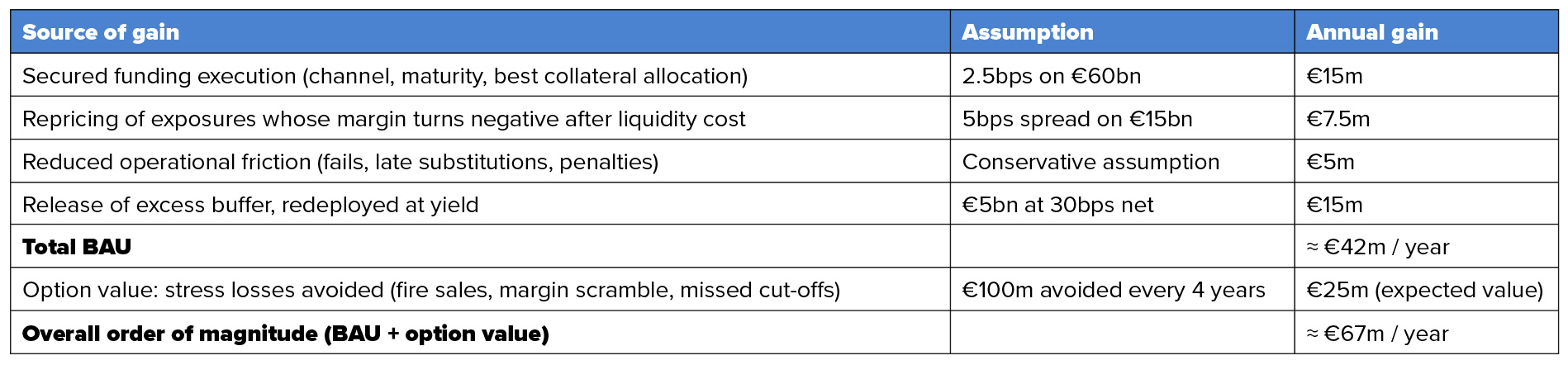
Two caveats condition the reading of these figures. The first: it would be misleading to see them as the consolidated P&L of a desk. Part corresponds to genuine external savings, funding costs and penalties actually avoided; part is internal allocation, the liquidity charge whose function is to force trade-offs between businesses, not to enrich the bank. Confusing the two would be double counting. The second caveat is the more important: none of these gains comes from monetisation as such. A bank can monetise its buffer massively and earn nothing, if no one routes, prices, disciplines, or escalates. All four sources of gain share the same origin — the combination of centralised execution, an internal price at marginal cost, budget discipline, and effective escalation rights. In other words, it is the mandate that pays, not the desk.
Measure what you can do, not what you hold
A mandate without measurement remains an intention. The indicators the ELM requires share one characteristic: they do not measure what the bank holds, they measure what it can execute. The difference leaps off the page as soon as they are listed.
The first block measures preparation. What share of the buffer is effectively monetised in BAU; what share is mobilisable within one day, within three, within five; and above all, what share has been tested in live conditions over the past 30 or 60 days. That last indicator is the most uncomfortable in the framework: an asset never tested is a hypothesis, not a reserve. To this is added execution dynamics — the median time to convert an asset into cash, channel by channel, and its measured degradation under stress; time-to-cash made enforceable.
The second block measures resistance. Average haircuts in BAU against haircuts in stress; the share of assets exposed to an eligibility exclusion; margin call absorption capacity at one day and at five days, set against simulated peaks; dependency by infrastructure, and access tests, passed or failed, on critical facilities. One of these figures, published internally, is usually enough to close the debate on the usefulness of the function.
The third block measures discipline, and closes the economic loop: implicit liquidity cost by activity, return on equity (ROE) contribution adjusted for that cost, volumes of low-risk but consumption-heavy repo, the share of liquidity usage validated within the framework, exceptions outside it, average time to arbitration. These last indicators monitor the organisation itself more than they monitor liquidity; that is deliberate. A framework that does not measure its own exceptions ends up as one more procedure.
The playbook, or the 13 minutes that will never happen
Return to the morning described in the fifth article of this series. It is 08:47. A margin call is due at 09:00, right in the window where the bulk of repo, margin and CCP flows concentrates. The collateral exists, at least on paper. But it sits with the wrong custodian, under the wrong governing law, or locked beyond the relevant cut-off window. 13 minutes to find out who and what your liquidity really depends on.
In an institution with a genuine crisis playbook, that morning simply never happens. The work has already been done.
At 08:00, the stress scenario is frozen around a few essential variables: client outflows, rising margin calls, deteriorating collateral quality. Stressed haircuts are predefined, priorities set, governance activated. Even reference-data changes are suspended: nothing executes cleanly while the parameters keep moving. At 08:30, the margin calls expected from the CCPs, stress add-ons included, are confirmed. The critical cut-offs and their time-to-cash are mapped. Margins and systemic payments take priority. At 09:30 comes a decision many organisations still improvise in a crisis: securing intraday funding. Unencumbered HQLA eligible at CCPs or central banks are mobilised first. Exposures carrying margin convexity are cut before they turn destabilising. At 10:30, the exposure decisions are taken. At 11:30, the execution orders have already gone out to the desks: collateral substitutions, compressions, unwinds and, where necessary, the rationing of certain clients on the basis of a triage mechanism prepared long in advance.
By noon, every decision that matters has already been taken. The fifth article asked the question: are your dependencies chosen or implicit? The playbook answers line by line: every implicit dependency, identified, tested, documented, becomes a chosen one. Every hidden operational friction becomes a known parameter. Every nasty surprise becomes a scenario already rehearsed. Those 13 minutes of discovery under fire will never happen — dissolved into months of preparation.
One truth, timestamped
The ELM cannot be run without a control tower: a single interface consolidating, in near-real-time, the operational truth of the bank — what is mobilisable, through which routes, at what speed — with alerts aligned on RAF thresholds rather than on end-of-day noise.
Its foundation is a collateral golden source built on five fields, not one more. Positions: quantity, ISIN, currency, location down to the custodian, settlement status, settled or pending, and freedom of movement. Encumbrance: what is already pledged, margins, triparty allocations, rehypothecation, and above all the genuinely mobilisable remainder, ranked by usage — margins first, survival funding next, franchise last. Eligibility by channel, bilateral, triparty, CCP, central bank, with versioned rules, because rules change and the data must record which one applies now. Haircuts, actual by channel and stressed by scenario, the bridge between inventory and convertibility: an HQLA becomes economically illiquid if its haircut turns prohibitive. Cut-offs and time-to-cash, finally: effective conversion time by route, operating windows, friction probability — turning a static stock into executable dynamics.
The doctrine is two-fold, and deliberately strict. If a field does not exist reliably intraday, it cannot be managed. And since liquidity data is contentious by nature — front office versus operations discrepancies, eligibility versions, CCP events — every figure carries a status, certified, under exception, or unreliable, within an explicit error budget: the ExCo knows at any moment whether it is steering on a stable truth or on a fragile aggregate. Liquidity that is compliant but unmeasurable within real cut-offs is not a capability; it is a hypothesis — and the control tower replaces the hypothesis with a capability: traceable, testable, arbitrable at the moment it matters.
Lunch on time
There remains a question this kind of article usually dodges: what will success look like? And it is here that the framework holds its final surprise, because the answer is: like nothing at all.
There will be no trophy. The war room will not be activated, for want of a crisis to its taste. The escalation committee will run its meetings in eight minutes, exceptions included. Internal audit, come looking for material, will leave with the most expensive phrase in the industry: nothing to report. On a day of genuine strain, the bank across the street will convene its crisis cell in urgency and disorder; at yours, someone will consult the morning’s liquidity tariff, run down a list of orders written months earlier, and go to lunch on time. The playbook will have produced its masterpiece: a non-event.
The budgetary paradox will be raised — tens of millions spent to manufacture boredom. The objection fails twice. First because the framework earns its keep in all weathers; the numbers are above. Second because boredom, in liquidity, is the rarest and most expensive product on the market; ask those who ran out of it one morning in September 2019, or one afternoon in the autumn of 2022.
The fifth article in this series tested all of this on ‘an ordinary Tuesday morning’, at 08:47, 13 minutes before a margin call. The ambition of everything above — TOM, RACI, RAF, internal pricing, KPIs, playbook, control tower — comes down, in the end, to a single sentence: giving Tuesday mornings back their mediocrity.
Only one thing is missing, and it is neither a tool, nor a budget, nor a hire. It is a signature. And there is only one floor of the bank it can come from.
What these firms already practise without naming it, most banks will have to build by naming it: that is what the ELM formalises. Nothing more — and that is precisely what makes its absence indefensible. In a regime where liquidity has become conditional, fragmented, and politically structured, every bank already executes liquidity trade-offs, every day; the point is simply that no one answers for them end to end. Leaving that responsibility diffuse amounts to flying blind through the core risk of banking. The ELM invents nothing; it gives an owner, a cross-functional perimeter and a line of accountability to a capability the organisation already exercises implicitly, piecemeal — and therefore dangerously.
For it is the formalisation that creates the capability: a trade-off without an owner cannot be steered, cannot be measured, and can be held against no one. As orchestrator of executable liquidity, the ELM coordinates every function that touches cash and collateral, from asset and liability management (ALM) and collateral management through to operations, to guarantee the effective convertibility of assets across every available channel, from bilateral repo to triparty and on to central bank facilities. But it does not merely coordinate: it executes. It answers for the velocity of monetisation, for access to infrastructures and for the trade-offs between liquidity, balance sheet and cost; it maintains, in normal conditions as in stress, a demonstrable conversion capability. It is this dual nature, orchestrator and executor, that prevents the capture of liquidity by the business lines, implicit arbitrage, and the silent destruction of value.
Naming the function is not enough; its operating model must be written down. The target operating model (TOM) sets out how the organisation runs — in steady state — to deliver executable, multi-channel liquidity. Its logic rests on one principle of separation: the party that creates liquidity, the party that uses it, and the party that secures it must no longer be confused. Treasury creates, through funding and institutional access; the repo desk uses, in the service of clients and P&L; collateral management aligns securities inventory with needs; ALM and risk secure, through the framework, the limits and the scenarios. The ELM, for its part, puts a price on liquidity, orchestrates, arbitrates and executes day to day. The separation looks obvious once written down; it exists formally almost nowhere, and it is its absence that makes implicit arbitrage possible.
The TOM applies that principle across three dimensions. The first delineates what the ELM does, orchestration, cross-functional arbitration, management of time-to-cash, and what the user teams continue to do; then how the two interact, with critical dependencies identified. The second governs: who decides what, with limited veto rights, escalation thresholds to the executive committee (ExCo), distinct rules for business as usual (BAU) and for stress, and a cadence of forums running from the daily coordination point to the crisis cell triggered by Risk Appetite Framework (RAF) thresholds. The third proves: the key processes, from collateral allocation to the activation of central bank facilities, are tooled, measured, and auditable — access tests, proof of mobilisability, traceability of exceptions. A TOM that delineates without governing produces an organisation chart; a TOM that governs without proving produces a doctrine. The three planes together produce a capability.
The end of comfortable ambiguity
On paper, the allocation of responsibilities for liquidity looks settled; in practice, it does not survive the first spike. 10 decisions typical of the liquidity, securities, and repo environment are enough to demonstrate the point. For each, a Responsible, Accountable, Consulted, Informed (RACI) matrix makes the allocation of roles explicit and enforceable, separating what belongs to orchestration from what belongs to usage. Two positions concentrate the stakes: the Responsible (R), who actually executes — arbitrates, trades, mobilises collateral; and the Accountable (A), who carries final responsibility and decides, alone and undivided. The question asked of each decision is simple: where does the ELM sit — and, above all, where did no one sit before it.
Calibrating the reserve. Two decisions found the framework. The buffer monetisation rate in target state (0, 25, 50 per cent and so on) and its associated fluctuation band: the ELM decides within the approved band (A); moving outside it is a matter for the ExCo. The target composition of the buffer, securities, currencies, maturities: Treasury and the ELM jointly build the conversion portfolio by channel (R); the ELM answers for implementation and for compliance with limits (A).
Routing the execution. Four decisions drive the daily funding mechanics. Collateral allocation by channel, bilateral, triparty, CCP, or central bank: the collateral teams, the repo desk, and the ELM execute the movements (R); the ELM answers for multi-channel orchestration and time-to-cash coherence (A). The choice of funding route for a given need: repo, Treasury and the ELM handle pricing, sizing, and execution (R); the ELM decides in BAU (A), with the ExCo stepping in directly whenever an exceptional backstop is to be activated or doctrine is to change. Collateral substitutions: the ELM arbitrates the cross-functional prioritisation between margins, funding, and clients (A). Operational cut-offs, exceptions and extensions included: the ELM decides on activation in the moment, within policy (A).
Holding under stress. Two decisions arise only under strain. Prioritising clients and flows, CCP margins, roll-overs, central bank access: execution is coordinated across the ELM, Treasury, repo, and operations (R); the ELM applies and arbitrates intraday (A). Activating the playbooks and the war room: the same teams in the front line (R); the ELM triggers on RAF thresholds and runs the operation (A); the ExCo takes over in crisis mode or for major exceptions.
Arbitrating the economics and the dependencies. Two decisions commit the structure. Sorting activities that are low risk but heavy in liquidity cost: finance and the ELM measure the implicit cost, build the scenarios and propose (R). Contracting — and unwinding — dependencies, GMRA, triparty agents, CCP access, counterparty onboarding: legal, repo and Treasury document and negotiate (R); the ELM orchestrates the overall plan and its multi-channel coherence (A); the ExCo decides the irreversible — exiting a counterparty, or changing triparty agent, for instance.
The logic is constant. The desks keep execution and their expertise, market-making, pricing, client relationships; the ELM concentrates final responsibility for orchestration and executes itself only where a decision affects monetisability, execution dynamics or RAF constraints; the ExCo decides only two things, doctrine and the irreversible. Far from adding a layer, this division reduces effective complexity: a single point of arbitration replaces inconsistent local optimisations, across Treasury, repo, operations, and risk. Under stress, the difference becomes decisive, because an unassigned capability is an undecided capability — and therefore a slow one. Read between the lines, the exercise says what matters most: of these 10 decisions, most had until now no designated final owner, only dispersed trade-offs whose sum no one carried. In practical terms, an independent ELM does not replace the expertise of the desks; it guarantees that this expertise executes on time, with stable priorities, and without letting liquidity become a common good — capturable, or ungovernable.
Putting risk appetite to the test
Liquidity risk appetite is defined by the demonstrated capacity to mobilise and monetise collateral quickly, at controlled cost, through secured channels, in normal conditions as in stress. The RAF manages that execution capability.
Most liquidity risk appetite frameworks measure stocks: a buffer level, a ratio, a theoretical survival horizon in days. The framework the new liquidity regime requires manages something else — a demonstrated capacity to mobilise and monetise collateral, quickly, at controlled cost, through secured channels. The nuance sounds semantic; it is structural. An appetite defined in stock is verified once a quarter; an appetite defined as execution capability is proven every day.
The perimeter widens accordingly. Beyond regulatory liquidity, Liquidity Coverage Ratio (LCR) and Net Stable Funding Ratio (NSFR), the framework covers economically mobilisable liquidity, repo and SFT activity, collateral, the infrastructures on which its transformation into cash depends, central counterparties (CCPs), triparty, central banks, and extends to the interactions between liquidity, balance sheet, and profitability. Nothing that conditions execution stays out of scope.
The core of the framework rests on three requirements. The first: prove convertibility. The institution commits to a buffer effectively monetised in BAU, in the region of 50 to 60 per cent, reversible within a day, and mobilisable at 80 to 90 per cent within five days under moderate stress; it also commits on speed, with target conversion times by channel and kinetic degradation measured under strain. An asset untested for too long, an excessive dependency on a single channel: each of these deviations constitutes a breach of the framework, not a footnote in the reporting.
The second requirement: control the external fragilities. No infrastructure, no counterparty may become a chokepoint — that link whose failure or restriction paralyses access to liquidity; hence concentration ceilings by channel and by jurisdiction, and central bank access tested monthly, not assumed. The same discipline applies to procyclicality: the bank must demonstrate its capacity to absorb a rise in haircuts without forced liquidation, and stressed margin calls over five days — failing which deleveraging stops being a scenario and becomes a mechanism.
The third requirement is economic and political. Economic: the implicit cost of liquidity is capped by activity, low-risk but liquidity-heavy repo is explicitly limited, and any activity structurally loss-making after liquidity cost triggers a mandatory review; that is the end of the silent destruction of value. Political: liquidity decisions are arbitrated by the ELM, the repo desk becomes once again an internal client of the framework rather than its owner, and any usage outside the framework, or left untracked, constitutes a breach. Risk appetite stops being a document and becomes a discipline.
Escalation follows a simple gradient: daily management by the ELM in BAU; a weekly liquidity committee on alert; ExCo arbitration and a corrective plan within 48 hours on breach; playbook activation, ELM in command, under stress. Four levels, four owners, no ambiguity about who decides when.
Very well — and what does it make?
One has to have presented an organisational project to a head of markets to know the real hierarchy of arguments. Resilience earns a nod; governance, a glance at the watch; the regulator, a sigh. Then comes the real question, the only one: ‘very well — and what does it make?’. The question is legitimate. A function that lives only off the fear of the next crisis will be the first one cut in the next cost plan, precisely because the crisis has not happened. The ELM must therefore defend itself on the ground where it is expected: the P&L. Put plainly, an insurance policy that pays out only in fires is a cost line on the other 364 days; the ELM, for its part, must earn its keep in all weathers.
The primary vocation of the ELM is not to generate P&L. Its central purpose remains the control of execution risk and the securing of executable liquidity. That defensive capability, however, mechanically creates strategic optionality in normal conditions, today largely under-exploited. By making the real liquidity and balance sheet constraints visible and arbitrable, the ELM allows a finer allocation of scarce resources, where fragmented organisations operate on incomplete or delayed signals.
That visibility translates into smarter trade-offs between collateral usage, funding cost, balance sheet consumption, and risk-adjusted profitability. Concretely, the ELM opens the way to sharper pricing of repo and SFT transactions, reflecting the true economic cost of the liquidity mobilised — to a differentiating capacity to serve selected clients in periods of strain, when liquidity is scarce and execution discipline becomes a selection factor — and to more dynamic balance sheet arbitrage, redeploying the balance sheet towards activities that create more value, without degrading overall resilience. This optionality rests on a reduction of operational uncertainty. The ELM does not create profit by construction; it avoids the silent destruction of value and restores the capacity to choose when, how, and at what price liquidity is committed. Over time, moreover, that control confers a durable competitive advantage: the bank is no longer condemned to take market conditions as given under stress, nor to over-optimise in BAU out of precaution. It can, on the contrary, deploy its balance sheet selectively, in line with its strategy and its risk appetite.
Serving, for instance, precisely where others withdraw. Consider the starting position in a period of market strain, for a bank without an ELM: haircuts rise, volatility spikes on peripheral sovereigns, CCP stress builds — the repo desks apply uniform cuts, pricing turns defensive and undifferentiated, some perfectly sound counterparties are refused or rationed, the bank shrinks activity to protect itself as a precaution. The result: immediate revenue loss, damaged client relationships, an under-used balance sheet at the worst possible moment.
Same situation with an ELM in place. The function holds a consolidated view of the genuinely mobilisable buffer, of the marginal cost of liquidity by channel (bilateral repo, triparty, central bank), of intraday and CCP constraints, and a validated cross-functional arbitration capacity. On that basis, the bank can keep repo access open for a limited number of strategic clients, price to the true cost of liquidity rather than to the worst case, and impose targeted conditions — shorter maturities, specific collateral — while strictly respecting its risk appetite. The bank does not take more risk. It chooses where to commit it: revenues preserved where the market contracts, the standing of a reliable counterparty reinforced, client relationships consolidated for the long term, a balance sheet used with discernment rather than by defensive reflex. Without an ELM, the bank protects itself by withdrawing. With one, it protects itself by arbitrating.
The end of free liquidity
A business case can always be argued with; a daily mechanism, far less easily. Here, then, is how these gains materialise, item by item, in the ordinary functioning of the framework.
The bank keeps a safety reserve of highly liquid high-quality liquid assets (HQLA). The ELM organises, day by day, how to put part of it to work without compromising safety — to raise cash quickly, pay on time, and get through the tense moments: crises, margin calls, large payments, cut-offs.
First, the ELM puts an internal price on liquidity. Teams that consume large amounts of cash, or immobilise scarce assets, pay that cost internally. The system forces the trade-offs: it weeds out activities that earn little but consume enormous liquidity, notably on an intraday basis — typically repo: large volumes, thin margins. As long as liquidity is free, every desk optimises its own P&L by externalising the cost of cash, of encumbrance, of CCP margin and of operational friction.
The whole discipline rests on a mechanism banks know well but do not always apply: internal transfer pricing. The principle of Funds Transfer Pricing (FTP) is old — each business pays the bank the internal cost of the funds it consumes; its variant, Liquidity Transfer Pricing (LTP), goes further, folding into the funding price what liquidity really costs in constraints: LCR, NSFR, encumbrance, CCP cost. But the tool only yields its discipline on three conditions — and that is where practice parts company with theory.
First condition: the price must be marginal, and matched to actual maturity. Concretely, a desk that locks up cash for 30 days pays the price of 30-day liquidity, not an average price smoothed across the whole balance sheet. The nuance sounds technical; it is decisive. An average price silently subsidises long usage with short liquidity, and every desk, rationally, exploits the subsidy: that is value destruction as daily routine, perfectly invisible in local P&Ls. Marginal pricing, maturity by maturity, removes the subsidy — and with it the incentive.
Second condition: the mechanism must reach down into the intraday. A transfer price calibrated on 30 days ignores the essence of today’s risk, which plays out within the day, between the morning’s margin calls and the afternoon’s cut-offs. Charging for liquidity by the day without charging for it within the day is like running a market position on closing prices: the average is right, and all the risk is elsewhere.
Third condition, the most political: liquidity budgets enforceable by business line, and an exception process that escalates to the ExCo. For there will be exceptions — activities structurally expensive in liquidity that the bank chooses to keep for franchise reasons; the framework does not forbid them, it requires that they be decided knowingly, at the right level, rather than granted by default in the blind spot of an average price.
Managed centrally by the ELM, this triptych — marginal pricing, intraday granularity, arbitrated exceptions — turns liquidity from a free resource into a metered one. And a metered resource changes behaviour without any committee having to intervene: the internal market does the disciplining.
In effect, waste is reduced (less liquidity immobilised for nothing), costly incidents are avoided (late payments, penalties, mishandled margin calls), and overall profitability improves as hidden costs become visible. Internally, the ELM charges the desks a liquidity price (FTP/liquidity charge). It is not external cash, but it recovers the true cost of liquidity and, above all, forces the trade-offs (fewer ‘thin margin/heavy cash’ volumes). Externally, through execution, the ELM optimises the cost of secured funding (repo/triparty/CCP/central bank) and captures the spread between badly funded and well funded (while avoiding penalties and fails). Through loss avoidance, fewer incidents — margins, cut-offs, emergency liquidations — mean less negative P&L in stress (which is often where the real return on investment sits). What a typical day would look like: every morning the ELM publishes the liquidity ‘tariff’ and the budgets by team; during the day it monitors spikes, sets priorities (pay X first, protect buffer Y), and triggers standardised operations to raise cash on time; in the evening it attributes the costs and documents the exceptions.
What an ELM makes: order of magnitude for a €100 billion buffer (conservative assumptions)
Starting assumption: HQLA buffer of €100 billion
Unencumbered floor: €40 billion
BAU mobilisable/monetisable share: €60 billion (repo/triparty/CCP/central bank), short-dated and reversible.
Figure 1
Two caveats condition the reading of these figures. The first: it would be misleading to see them as the consolidated P&L of a desk. Part corresponds to genuine external savings, funding costs and penalties actually avoided; part is internal allocation, the liquidity charge whose function is to force trade-offs between businesses, not to enrich the bank. Confusing the two would be double counting. The second caveat is the more important: none of these gains comes from monetisation as such. A bank can monetise its buffer massively and earn nothing, if no one routes, prices, disciplines, or escalates. All four sources of gain share the same origin — the combination of centralised execution, an internal price at marginal cost, budget discipline, and effective escalation rights. In other words, it is the mandate that pays, not the desk.
Measure what you can do, not what you hold
A mandate without measurement remains an intention. The indicators the ELM requires share one characteristic: they do not measure what the bank holds, they measure what it can execute. The difference leaps off the page as soon as they are listed.
The first block measures preparation. What share of the buffer is effectively monetised in BAU; what share is mobilisable within one day, within three, within five; and above all, what share has been tested in live conditions over the past 30 or 60 days. That last indicator is the most uncomfortable in the framework: an asset never tested is a hypothesis, not a reserve. To this is added execution dynamics — the median time to convert an asset into cash, channel by channel, and its measured degradation under stress; time-to-cash made enforceable.
The second block measures resistance. Average haircuts in BAU against haircuts in stress; the share of assets exposed to an eligibility exclusion; margin call absorption capacity at one day and at five days, set against simulated peaks; dependency by infrastructure, and access tests, passed or failed, on critical facilities. One of these figures, published internally, is usually enough to close the debate on the usefulness of the function.
The third block measures discipline, and closes the economic loop: implicit liquidity cost by activity, return on equity (ROE) contribution adjusted for that cost, volumes of low-risk but consumption-heavy repo, the share of liquidity usage validated within the framework, exceptions outside it, average time to arbitration. These last indicators monitor the organisation itself more than they monitor liquidity; that is deliberate. A framework that does not measure its own exceptions ends up as one more procedure.
The playbook, or the 13 minutes that will never happen
Return to the morning described in the fifth article of this series. It is 08:47. A margin call is due at 09:00, right in the window where the bulk of repo, margin and CCP flows concentrates. The collateral exists, at least on paper. But it sits with the wrong custodian, under the wrong governing law, or locked beyond the relevant cut-off window. 13 minutes to find out who and what your liquidity really depends on.
In an institution with a genuine crisis playbook, that morning simply never happens. The work has already been done.
At 08:00, the stress scenario is frozen around a few essential variables: client outflows, rising margin calls, deteriorating collateral quality. Stressed haircuts are predefined, priorities set, governance activated. Even reference-data changes are suspended: nothing executes cleanly while the parameters keep moving. At 08:30, the margin calls expected from the CCPs, stress add-ons included, are confirmed. The critical cut-offs and their time-to-cash are mapped. Margins and systemic payments take priority. At 09:30 comes a decision many organisations still improvise in a crisis: securing intraday funding. Unencumbered HQLA eligible at CCPs or central banks are mobilised first. Exposures carrying margin convexity are cut before they turn destabilising. At 10:30, the exposure decisions are taken. At 11:30, the execution orders have already gone out to the desks: collateral substitutions, compressions, unwinds and, where necessary, the rationing of certain clients on the basis of a triage mechanism prepared long in advance.
By noon, every decision that matters has already been taken. The fifth article asked the question: are your dependencies chosen or implicit? The playbook answers line by line: every implicit dependency, identified, tested, documented, becomes a chosen one. Every hidden operational friction becomes a known parameter. Every nasty surprise becomes a scenario already rehearsed. Those 13 minutes of discovery under fire will never happen — dissolved into months of preparation.
One truth, timestamped
The ELM cannot be run without a control tower: a single interface consolidating, in near-real-time, the operational truth of the bank — what is mobilisable, through which routes, at what speed — with alerts aligned on RAF thresholds rather than on end-of-day noise.
Its foundation is a collateral golden source built on five fields, not one more. Positions: quantity, ISIN, currency, location down to the custodian, settlement status, settled or pending, and freedom of movement. Encumbrance: what is already pledged, margins, triparty allocations, rehypothecation, and above all the genuinely mobilisable remainder, ranked by usage — margins first, survival funding next, franchise last. Eligibility by channel, bilateral, triparty, CCP, central bank, with versioned rules, because rules change and the data must record which one applies now. Haircuts, actual by channel and stressed by scenario, the bridge between inventory and convertibility: an HQLA becomes economically illiquid if its haircut turns prohibitive. Cut-offs and time-to-cash, finally: effective conversion time by route, operating windows, friction probability — turning a static stock into executable dynamics.
The doctrine is two-fold, and deliberately strict. If a field does not exist reliably intraday, it cannot be managed. And since liquidity data is contentious by nature — front office versus operations discrepancies, eligibility versions, CCP events — every figure carries a status, certified, under exception, or unreliable, within an explicit error budget: the ExCo knows at any moment whether it is steering on a stable truth or on a fragile aggregate. Liquidity that is compliant but unmeasurable within real cut-offs is not a capability; it is a hypothesis — and the control tower replaces the hypothesis with a capability: traceable, testable, arbitrable at the moment it matters.
Lunch on time
There remains a question this kind of article usually dodges: what will success look like? And it is here that the framework holds its final surprise, because the answer is: like nothing at all.
There will be no trophy. The war room will not be activated, for want of a crisis to its taste. The escalation committee will run its meetings in eight minutes, exceptions included. Internal audit, come looking for material, will leave with the most expensive phrase in the industry: nothing to report. On a day of genuine strain, the bank across the street will convene its crisis cell in urgency and disorder; at yours, someone will consult the morning’s liquidity tariff, run down a list of orders written months earlier, and go to lunch on time. The playbook will have produced its masterpiece: a non-event.
The budgetary paradox will be raised — tens of millions spent to manufacture boredom. The objection fails twice. First because the framework earns its keep in all weathers; the numbers are above. Second because boredom, in liquidity, is the rarest and most expensive product on the market; ask those who ran out of it one morning in September 2019, or one afternoon in the autumn of 2022.
The fifth article in this series tested all of this on ‘an ordinary Tuesday morning’, at 08:47, 13 minutes before a margin call. The ambition of everything above — TOM, RACI, RAF, internal pricing, KPIs, playbook, control tower — comes down, in the end, to a single sentence: giving Tuesday mornings back their mediocrity.
Only one thing is missing, and it is neither a tool, nor a budget, nor a hire. It is a signature. And there is only one floor of the bank it can come from.
NO FEE, NO RISK
100% ON RETURNS If you invest in only one securities finance news source this year, make sure it is your free subscription to Securities Finance Times
100% ON RETURNS If you invest in only one securities finance news source this year, make sure it is your free subscription to Securities Finance Times