The engine powering modern markets
22 June 2026
Thomas Ingram of S&P Global Market Intelligence discusses the symbiotic relationship
between technology and data, and how this is transforming the securities finance market
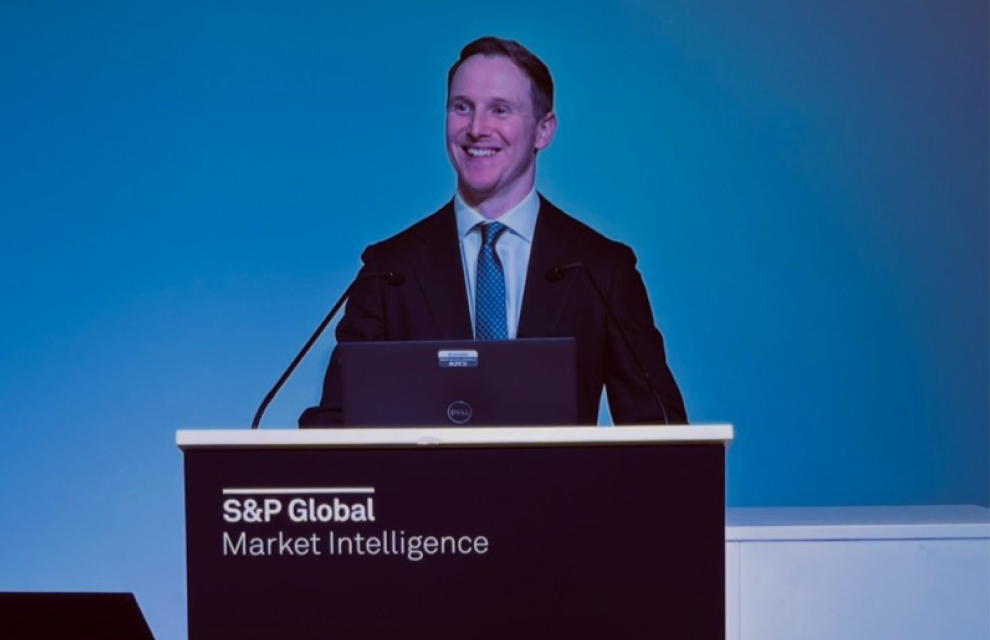 Image: Thomas Ingram
In modern financial markets, data and technology are often discussed as separate forces. One generates information; the other processes it. In reality, the relationship is far more intertwined. Each fuels the other in a continuous cycle of improvement, a feedback loop that is quietly transforming how markets function. Companies like S&P Global Market Intelligence (SPGMI)?sit at the centre of this loop, using technology to capture, integrate, and distribute richer datasets, and then building new tools and platforms that are powered by those very datasets.
Nowhere is this more visible than in securities finance. The interaction between data and technology does not simply enable better analysis or faster trading; it reshapes the structure of the market itself. As technology evolves, it unlocks deeper, broader, and more dynamic datasets. Those richer datasets then power more sophisticated analytics, automation, AI, and decision-making tools. The outcome is a market ecosystem that is more connected, more transparent, and increasingly driven by real-time intelligence, much of it delivered through integrated data and solutions from providers such as SPGMI.
This symbiotic relationship, where advances in technology create better data, and better data drives new technological innovation, is rapidly becoming one of the defining characteristics of modern global financial markets, and securities finance is one of the clearest examples of this transformation in action.
When separate markets become one system
For decades, many areas of securities finance operated as parallel but separate worlds. Repo desks, securities lending teams, derivatives traders, and treasury functions each had their own datasets, pricing signals, and analytical tools. Information moved slowly between these domains, if at all. Technology is now dissolving those boundaries in securities finance.
Advances in data integration, analytics platforms, and automated collateral optimisation have allowed historically siloed markets, particularly repo and securities lending, to converge into a more unified financing ecosystem. SPGMI has played a key role by delivering?an integrated securities finance dataset?that brings together securities lending activity, repo pricing, and broader fixed income information into a single analytical framework.
Rather than viewing these markets independently, institutions increasingly manage them as interconnected components of a single balance sheet strategy. A trader evaluating a financing opportunity can now consider funding rates, collateral availability, balance sheet capacity, and market demand across multiple instruments simultaneously. The expansion of general collateral (GC) repo curves — spanning major currencies and extending up to four-year maturities — further adds a powerful new dimension to integrated financing strategy.
Instead of relying on fragmented snapshots, traders can operate within a consolidated intelligence layer that provides a real-time view of financing conditions across the market, sourced from unified feeds and platforms offered by SPGMI.
This shift is not simply technological; it changes how decisions are made. Risk management, liquidity planning, and collateral allocation can now be optimised holistically rather than within product-specific silos. The combined securities finance and repo data feed, curated, normalised, and distributed by SPGMI, gives institutions a clearer, more consistent picture of the financing landscape and supports a more coherent, cross-market strategy.
The rise of real-time market awareness
Another area where data and technology partner to support financial markets is speed. In securities finance, the ability to understand market dynamics in real time has historically been limited. Many datasets were only available after close of business the previous day, meaning market participants were effectively navigating using yesterday’s information. That paradigm is changing rapidly.
The rise of?intraday and real-time datasets?is introducing a new level of transparency into financing markets. Instead of waiting for end-of-day reports, firms can now monitor borrowing demand, lending supply, and price movements as they evolve throughout the trading day. SPGMI has invested in building out?intraday trade-flow history and new ‘live’ metrics, allowing clients to track estimated borrow costs, net trade flows, and other key indicators on an hourly or even more frequent basis.
This shift has two important consequences. First, it shortens the feedback loop between market activity and decision-making. Traders and risk managers can identify dislocations as they develop, adjusting pricing, supply, or collateral usage in near real time. Second, it transforms historical analysis. With seven years of historical intraday data alongside traditional settled datasets, firms gain access to a richer view of market behaviour.
A recent research note by SPGMI highlighted that intraday flow is a leading indicator, predicting 70 per cent of significant moves in the settled data for US and APAC equities. Patterns that were once invisible, such as early signals of short-interest shifts or funding stress, can now be detected and studied systematically.
Observing these flows allow market participants to anticipate directional changes in demand before they appear in official settlement statistics. This level of visibility is possible because of technological advances in?data storage, cloud delivery, and API-based access, as well as because data companies like SPGMI have committed to capturing, structuring, and distributing intraday information at scale.
From screens to systems: The evolution of data consumption
For much of the past two decades, financial data was primarily consumed through desktop tools. Analysts downloaded spreadsheets, manipulated data manually, and generated insights in isolation.
Today, the industry is moving rapidly toward a different model, where data flows directly into?enterprise systems and automated workflows.
Application programming interfaces (APIs) allow institutions to request specific datasets on demand, integrating them directly into trading models, risk systems, and internal dashboards. Bulk data feeds provide structured datasets that can be ingested into centralised data warehouses or cloud platforms for large-scale analysis. SPGMI has been at the forefront of this shift, offering securities finance data via flexible APIs, flat-file feeds, and cloud-native distribution channels that fit seamlessly into modern architectures.
This shift from screen-based consumption to workflow-driven integration is transforming how financial institutions operate. Instead of users navigating multiple interfaces to gather information, data becomes embedded directly within the processes that drive trading, financing, and risk management. For securities finance desks, this means:
• Lending and repo data feeding directly into?collateral optimisation engines.
• Borrow demand and utilisation metrics populating?funding and liquidity dashboards.
• Standardised identifiers enabling easy joins with?bond pricing, CDS, and index datasets?supplied by SPGMI.
In practical terms, analysts and traders spend less time gathering information and more time interpreting it. Technology makes it possible to move data effortlessly; and our integrated offerings at SPGMI ensure that the data moving through these systems is robust, consistent, and aligned across products.
AI’s dependence on high-quality data
Artificial intelligence has quickly become one of the most discussed technologies in financial markets. Yet its success in securities finance depends on something far less glamorous: high-quality data.
Large language models and other AI systems excel at interpreting complex information and presenting insights in intuitive ways. They can translate natural-language questions into queries, generate analytical summaries, and highlight patterns that might otherwise be overlooked. But without reliable, well-structured datasets, these models quickly become unreliable.
The most effective AI implementations therefore follow a clear architecture. Databases and analytical engines serve as the authoritative source of truth, storing verified datasets and performing calculations. AI systems sit on top of this foundation, acting as an interaction layer that helps users navigate information more efficiently. In this model, AI does not replace data infrastructure, it amplifies it.
S&P Global Market Intelligence is building AI solutions explicitly on top of its trusted securities finance datasets. Emerging technologies such as?AI agents and structured retrieval frameworks?allow models to interact directly with SPGMI databases and analytics tools. These agents break complex questions into smaller tasks, retrieve relevant data from entitlement-aware sources, and synthesize the results into understandable insights.
For financial professionals, the experience becomes far more intuitive. Instead of constructing complex spreadsheets or writing code, users can simply ask questions and receive?structured answers, tables, visualisations, and narrative explanations generated in seconds.
Tools such as an LLM-driven agentic copilot for Securities Finance League Tables exemplify this approach: the intelligence of the model is grounded in the quality and breadth of our data.
Predicting markets rather than observing them
One of the most powerful outcomes of the data–technology feedback loop is the rise of?predictive analytics?in
securities finance.
Historically, analysis focused on explaining past activity: why borrow demand increased, why collateral spreads widened, or why liquidity shifted across markets. Today, the availability of deep historical datasets, combined with advances in computational power and modelling techniques, allows institutions to move beyond explanation and into forecasting.
Machine learning models can analyse patterns across lending demand, collateral usage, financing spreads, and market liquidity to identify signals that precede major market shifts. These models can then generate forecasts that help institutions position themselves ahead of emerging trends. S&P Global Market Intelligence supports this by supplying?multi-year histories of settled and intraday data, enriched with context from related markets such as bonds, CDS, ETFs, and indices.
Predictive analytics is particularly valuable in areas such as:
• Anticipating changes in?securities lending demand
• Forecasting?collateral scarcity?or crowding
• Identifying early signs of?market or funding stress
• Detecting shifts in?short selling activity
The ability to anticipate these developments, even by a small margin, can create meaningful advantages in funding strategy and risk management. And once again, the process is circular: better technology enables deeper and more granular datasets; deeper datasets enable better models; and better models create demand for even more advanced technology and richer data, driving further investment from firms.
Breaking down the last data silos
As financial institutions continue to modernise their infrastructure, one theme appears consistently: the gradual dismantling of data silos.
Cloud-native platforms, standardised data models, and interoperable APIs are making it easier than ever to link datasets that were previously isolated. Pricing data, reference data, transaction activity, and risk metrics can now be combined into a unified analytical environment. S&P Global Market Intelligence supports this with?standardised securities finance, fixed income, and reference data, designed to be easily joined and consumed across desks and regions.
The implications extend far beyond operational efficiency. By connecting datasets across asset classes, desks, and even institutions, the industry is moving toward a more transparent and resilient market structure. Participants gain a clearer view of liquidity conditions, collateral flows, and funding pressures across the global financial system.
In effect, markets are becoming more observable and more intelligible because technology makes integration possible and data providers like SPGMI supply the consistent, high-quality content that integration depends on.
The core of modern market intelligence
The relationship between data and technology is often described as complementary. In reality, it is something stronger: a?symbiosis.
Advances in technology make it possible to capture, store, and distribute vast quantities of financial data. That data then fuels the next generation of analytical tools, automation platforms, and AI systems. Each innovation strengthens the other, creating a continuous cycle of improvement.
In securities finance, this cycle is becoming the core engine of modern market intelligence. Institutions that embrace this relationship gain more than operational efficiency.
They gain a deeper understanding of market structure, faster insight into emerging risks, and the ability to identify opportunities that were previously hidden in fragmented data.
S&P Global Market Intelligence’s integrated datasets, intraday transparency, workflow-ready delivery, and AI-enabled tools are all designed to help clients harness this ecosystem.
In a world where information moves at extraordinary speed, the most successful firms will not simply collect more data or build more technology. They will recognise that the two are inseparable and will partner with data and analytics providers that are investing in both. Because in modern financial markets, data does not just inform decisions. Together with technology, it?powers the entire financial system.
Nowhere is this more visible than in securities finance. The interaction between data and technology does not simply enable better analysis or faster trading; it reshapes the structure of the market itself. As technology evolves, it unlocks deeper, broader, and more dynamic datasets. Those richer datasets then power more sophisticated analytics, automation, AI, and decision-making tools. The outcome is a market ecosystem that is more connected, more transparent, and increasingly driven by real-time intelligence, much of it delivered through integrated data and solutions from providers such as SPGMI.
This symbiotic relationship, where advances in technology create better data, and better data drives new technological innovation, is rapidly becoming one of the defining characteristics of modern global financial markets, and securities finance is one of the clearest examples of this transformation in action.
When separate markets become one system
For decades, many areas of securities finance operated as parallel but separate worlds. Repo desks, securities lending teams, derivatives traders, and treasury functions each had their own datasets, pricing signals, and analytical tools. Information moved slowly between these domains, if at all. Technology is now dissolving those boundaries in securities finance.
Advances in data integration, analytics platforms, and automated collateral optimisation have allowed historically siloed markets, particularly repo and securities lending, to converge into a more unified financing ecosystem. SPGMI has played a key role by delivering?an integrated securities finance dataset?that brings together securities lending activity, repo pricing, and broader fixed income information into a single analytical framework.
Rather than viewing these markets independently, institutions increasingly manage them as interconnected components of a single balance sheet strategy. A trader evaluating a financing opportunity can now consider funding rates, collateral availability, balance sheet capacity, and market demand across multiple instruments simultaneously. The expansion of general collateral (GC) repo curves — spanning major currencies and extending up to four-year maturities — further adds a powerful new dimension to integrated financing strategy.
Instead of relying on fragmented snapshots, traders can operate within a consolidated intelligence layer that provides a real-time view of financing conditions across the market, sourced from unified feeds and platforms offered by SPGMI.
This shift is not simply technological; it changes how decisions are made. Risk management, liquidity planning, and collateral allocation can now be optimised holistically rather than within product-specific silos. The combined securities finance and repo data feed, curated, normalised, and distributed by SPGMI, gives institutions a clearer, more consistent picture of the financing landscape and supports a more coherent, cross-market strategy.
The rise of real-time market awareness
Another area where data and technology partner to support financial markets is speed. In securities finance, the ability to understand market dynamics in real time has historically been limited. Many datasets were only available after close of business the previous day, meaning market participants were effectively navigating using yesterday’s information. That paradigm is changing rapidly.
The rise of?intraday and real-time datasets?is introducing a new level of transparency into financing markets. Instead of waiting for end-of-day reports, firms can now monitor borrowing demand, lending supply, and price movements as they evolve throughout the trading day. SPGMI has invested in building out?intraday trade-flow history and new ‘live’ metrics, allowing clients to track estimated borrow costs, net trade flows, and other key indicators on an hourly or even more frequent basis.
This shift has two important consequences. First, it shortens the feedback loop between market activity and decision-making. Traders and risk managers can identify dislocations as they develop, adjusting pricing, supply, or collateral usage in near real time. Second, it transforms historical analysis. With seven years of historical intraday data alongside traditional settled datasets, firms gain access to a richer view of market behaviour.
A recent research note by SPGMI highlighted that intraday flow is a leading indicator, predicting 70 per cent of significant moves in the settled data for US and APAC equities. Patterns that were once invisible, such as early signals of short-interest shifts or funding stress, can now be detected and studied systematically.
Observing these flows allow market participants to anticipate directional changes in demand before they appear in official settlement statistics. This level of visibility is possible because of technological advances in?data storage, cloud delivery, and API-based access, as well as because data companies like SPGMI have committed to capturing, structuring, and distributing intraday information at scale.
From screens to systems: The evolution of data consumption
For much of the past two decades, financial data was primarily consumed through desktop tools. Analysts downloaded spreadsheets, manipulated data manually, and generated insights in isolation.
Today, the industry is moving rapidly toward a different model, where data flows directly into?enterprise systems and automated workflows.
Application programming interfaces (APIs) allow institutions to request specific datasets on demand, integrating them directly into trading models, risk systems, and internal dashboards. Bulk data feeds provide structured datasets that can be ingested into centralised data warehouses or cloud platforms for large-scale analysis. SPGMI has been at the forefront of this shift, offering securities finance data via flexible APIs, flat-file feeds, and cloud-native distribution channels that fit seamlessly into modern architectures.
This shift from screen-based consumption to workflow-driven integration is transforming how financial institutions operate. Instead of users navigating multiple interfaces to gather information, data becomes embedded directly within the processes that drive trading, financing, and risk management. For securities finance desks, this means:
• Lending and repo data feeding directly into?collateral optimisation engines.
• Borrow demand and utilisation metrics populating?funding and liquidity dashboards.
• Standardised identifiers enabling easy joins with?bond pricing, CDS, and index datasets?supplied by SPGMI.
In practical terms, analysts and traders spend less time gathering information and more time interpreting it. Technology makes it possible to move data effortlessly; and our integrated offerings at SPGMI ensure that the data moving through these systems is robust, consistent, and aligned across products.
AI’s dependence on high-quality data
Artificial intelligence has quickly become one of the most discussed technologies in financial markets. Yet its success in securities finance depends on something far less glamorous: high-quality data.
Large language models and other AI systems excel at interpreting complex information and presenting insights in intuitive ways. They can translate natural-language questions into queries, generate analytical summaries, and highlight patterns that might otherwise be overlooked. But without reliable, well-structured datasets, these models quickly become unreliable.
The most effective AI implementations therefore follow a clear architecture. Databases and analytical engines serve as the authoritative source of truth, storing verified datasets and performing calculations. AI systems sit on top of this foundation, acting as an interaction layer that helps users navigate information more efficiently. In this model, AI does not replace data infrastructure, it amplifies it.
S&P Global Market Intelligence is building AI solutions explicitly on top of its trusted securities finance datasets. Emerging technologies such as?AI agents and structured retrieval frameworks?allow models to interact directly with SPGMI databases and analytics tools. These agents break complex questions into smaller tasks, retrieve relevant data from entitlement-aware sources, and synthesize the results into understandable insights.
For financial professionals, the experience becomes far more intuitive. Instead of constructing complex spreadsheets or writing code, users can simply ask questions and receive?structured answers, tables, visualisations, and narrative explanations generated in seconds.
Tools such as an LLM-driven agentic copilot for Securities Finance League Tables exemplify this approach: the intelligence of the model is grounded in the quality and breadth of our data.
Predicting markets rather than observing them
One of the most powerful outcomes of the data–technology feedback loop is the rise of?predictive analytics?in
securities finance.
Historically, analysis focused on explaining past activity: why borrow demand increased, why collateral spreads widened, or why liquidity shifted across markets. Today, the availability of deep historical datasets, combined with advances in computational power and modelling techniques, allows institutions to move beyond explanation and into forecasting.
Machine learning models can analyse patterns across lending demand, collateral usage, financing spreads, and market liquidity to identify signals that precede major market shifts. These models can then generate forecasts that help institutions position themselves ahead of emerging trends. S&P Global Market Intelligence supports this by supplying?multi-year histories of settled and intraday data, enriched with context from related markets such as bonds, CDS, ETFs, and indices.
Predictive analytics is particularly valuable in areas such as:
• Anticipating changes in?securities lending demand
• Forecasting?collateral scarcity?or crowding
• Identifying early signs of?market or funding stress
• Detecting shifts in?short selling activity
The ability to anticipate these developments, even by a small margin, can create meaningful advantages in funding strategy and risk management. And once again, the process is circular: better technology enables deeper and more granular datasets; deeper datasets enable better models; and better models create demand for even more advanced technology and richer data, driving further investment from firms.
Breaking down the last data silos
As financial institutions continue to modernise their infrastructure, one theme appears consistently: the gradual dismantling of data silos.
Cloud-native platforms, standardised data models, and interoperable APIs are making it easier than ever to link datasets that were previously isolated. Pricing data, reference data, transaction activity, and risk metrics can now be combined into a unified analytical environment. S&P Global Market Intelligence supports this with?standardised securities finance, fixed income, and reference data, designed to be easily joined and consumed across desks and regions.
The implications extend far beyond operational efficiency. By connecting datasets across asset classes, desks, and even institutions, the industry is moving toward a more transparent and resilient market structure. Participants gain a clearer view of liquidity conditions, collateral flows, and funding pressures across the global financial system.
In effect, markets are becoming more observable and more intelligible because technology makes integration possible and data providers like SPGMI supply the consistent, high-quality content that integration depends on.
The core of modern market intelligence
The relationship between data and technology is often described as complementary. In reality, it is something stronger: a?symbiosis.
Advances in technology make it possible to capture, store, and distribute vast quantities of financial data. That data then fuels the next generation of analytical tools, automation platforms, and AI systems. Each innovation strengthens the other, creating a continuous cycle of improvement.
In securities finance, this cycle is becoming the core engine of modern market intelligence. Institutions that embrace this relationship gain more than operational efficiency.
They gain a deeper understanding of market structure, faster insight into emerging risks, and the ability to identify opportunities that were previously hidden in fragmented data.
S&P Global Market Intelligence’s integrated datasets, intraday transparency, workflow-ready delivery, and AI-enabled tools are all designed to help clients harness this ecosystem.
In a world where information moves at extraordinary speed, the most successful firms will not simply collect more data or build more technology. They will recognise that the two are inseparable and will partner with data and analytics providers that are investing in both. Because in modern financial markets, data does not just inform decisions. Together with technology, it?powers the entire financial system.
NO FEE, NO RISK
100% ON RETURNS If you invest in only one securities finance news source this year, make sure it is your free subscription to Securities Finance Times
100% ON RETURNS If you invest in only one securities finance news source this year, make sure it is your free subscription to Securities Finance Times