Rising yields, rising demand: What lending data says about sovereign bonds
29 September 2026
Matt Chessum, executive director, equity and analytic products at S&P Global Market Intelligence, reviews recent trends in the bond market across Europe, the UK, and Japan and how these movements are impacting industry behaviour
 Image: Shutterstock
Government bond markets are becoming more active, more selective, and more country-specific. Higher debt issuance, persistent inflation risk, central bank uncertainty, and closer scrutiny of fiscal credibility have pushed yields higher across major sovereign markets, with the pressure most visible at the long end of the curve. Recent auctions and issuance events have reinforced the point. The recent US 30-year Treasury auction on 10 September cleared at 5.308 per cent, above the prior month’s 5.216 per cent, for example. Securities lending data is capturing that shift.
Market value on loan has increased across most major government bond markets during 2026, pointing to greater use of sovereign debt in trading and financing strategies. As of 18 September, US government bonds accounted for US$1.394 trillion in market value on loan.
Europe followed at US$598.7 billion, with France at US$150.4 billion, Germany at US$141.1 billion, the UK at US$122.8 billion, Italy at US$62.3 billion, and Spain at US$28.0 billion.
These balances highlight the scale of government bonds as working assets in fixed income markets, not simply long-term portfolio holdings.
The year-over-year (YoY) trend is even more revealing. Market value on loan rose 37.4 per cent in the US, 27 per cent in the UK, 23.1 per cent in Germany, 22.9 per cent across Europe, 16.8 per cent in Italy, 15.4 per cent in France, 8.2 per cent in Japan, and 71.0 per cent in Spain.
The breadth of the increase suggests that demand is not limited to isolated pockets of market stress. Instead, investors appear to be borrowing government bonds to manage duration exposure, support financing activity, meet collateral needs, and position around shifting sovereign risk premiums.
Rising yields can attract buyers seeking income, but they also increase mark-to-market risk for existing holders, particularly in longer maturities. That tension creates demand for hedging and relative value strategies. Borrowed bonds can be used to reduce duration, hedge spread exposure, support futures basis trades, cover settlement obligations, or finance cash bond positions.
European government bonds value on loan ($B)
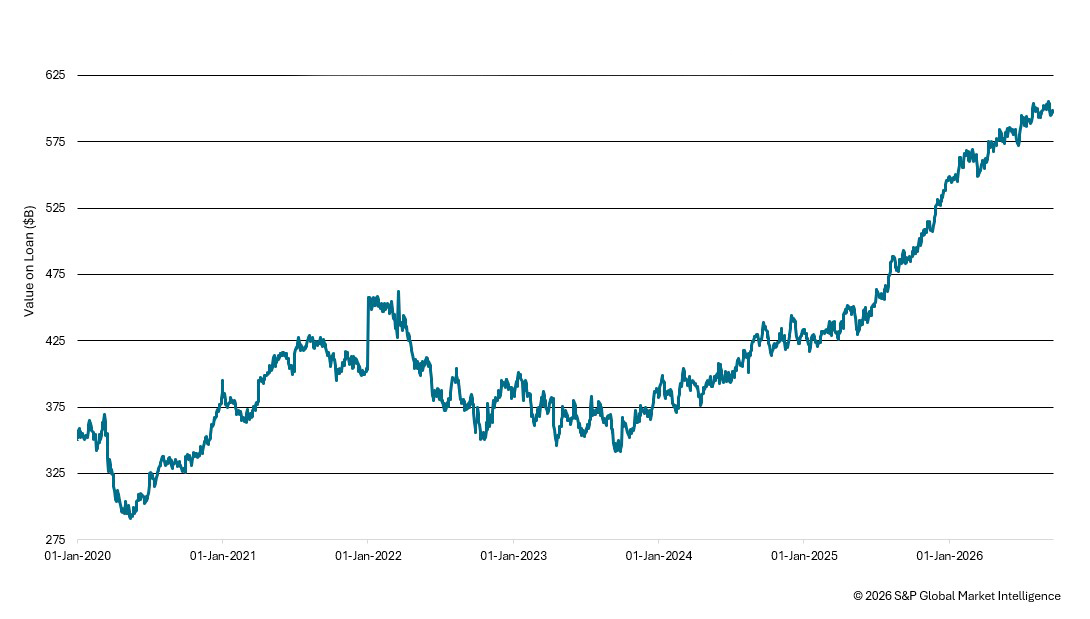
Rising market value on loan suggests investors are using sovereign debt more actively to hedge duration, finance positions, and trade relative value opportunities.
Auction calendars and new issuance also matter. The US Treasury’s 17 September announcement included upcoming auctions for US$69 billion of 2-year notes on 22 September, US$70 billion of 5-year notes on 23 September, and US$44 billion of 7-year notes on 24 September.
When larger volumes of government debt come to market, participants may need greater access to inventory to intermediate supply, hedge auction risk, or manage settlement flows. A larger balance on loan therefore points to a market where sovereign debt is being put to work more actively.
The US provides the clearest example of scale. With nearly US$1.4 trillion on loan and a 37.4 per cent annual increase, Treasury lending activity points to stronger demand for financing and hedging in the world’s deepest sovereign bond market. Supply remains a central feature of the Treasury backdrop. Elevated long-dated yields, a larger supply pipeline, and ongoing debate over duration risk are likely contributing to greater use of Treasuries across lending and collateral channels.
Japan adds an important APAC perspective. Market value on loan increased 8.2 per cent YoY, a more modest rise than in the US or Europe but still notable given the shift in Japan’s rates backdrop.
Recent Japanese government bond (JGB) auctions show that long-end yields are moving higher, including the 2 September 30-year auction, which cleared above the August level. This suggests investors are paying closer attention to duration risk, liquidity, and collateral demand in Japan.
In lending markets, the YoY rise points to greater use of JGBs for hedging and duration management as Japan’s bond market becomes more active after a prolonged period of suppressed volatility.
Europe shows a different pattern. The region’s US$598.7 billion balance, up 22.9 per cent YoY, indicates broader demand for access to sovereign inventory. Within that total, investors are differentiating more clearly between core, semi-core, and peripheral markets.
Germany’s US$141.1 billion balance and 23.1 per cent annual increase point to demand for high-quality collateral and benchmark hedging instruments. France’s US$150.4 billion balance, up 15.4 per cent, reflects a market more focused on fiscal credibility, debt dynamics, and political uncertainty.
France and Italy show how lending data can highlight different types of sovereign risk. In France, lending balances have risen as the OAT-Bund spread moved close to 100 basis points, suggesting investors are not only responding to higher yields but also managing relative sovereign risk. Recent French issuance has kept fiscal credibility and long-end risk premia in focus.
Italy offers a contrast: market value on loan reached US$62.3 billion, up 16.8 per cent YoY and moving back toward early-2020 levels after the pandemic-era decline. While Italian yields have also risen, the relative story has at times been more constructive as investors reassessed risk elsewhere in the eurozone. The comparison reinforces the wider theme: as yield, supply and fiscal risks diverge across markets, investors appear to be using borrowed bonds to manage exposures more actively.
That is the central point for securities lending. Higher yields and heavier issuance are changing how investors use government bonds. They are not only buying sovereign debt for income; they are also borrowing it to hedge duration, finance positions, manage collateral, and respond to country-specific risk.
The rise in market value on loan across the US, Europe, and Japan suggests government bonds are becoming more active tools in fixed income portfolios. For beneficial owners, this creates opportunity, but it also makes disciplined pricing, collateral oversight, and issue-level monitoring more important as supply, liquidity, and risk conditions continue to shift.
Market value on loan has increased across most major government bond markets during 2026, pointing to greater use of sovereign debt in trading and financing strategies. As of 18 September, US government bonds accounted for US$1.394 trillion in market value on loan.
Europe followed at US$598.7 billion, with France at US$150.4 billion, Germany at US$141.1 billion, the UK at US$122.8 billion, Italy at US$62.3 billion, and Spain at US$28.0 billion.
These balances highlight the scale of government bonds as working assets in fixed income markets, not simply long-term portfolio holdings.
The year-over-year (YoY) trend is even more revealing. Market value on loan rose 37.4 per cent in the US, 27 per cent in the UK, 23.1 per cent in Germany, 22.9 per cent across Europe, 16.8 per cent in Italy, 15.4 per cent in France, 8.2 per cent in Japan, and 71.0 per cent in Spain.
The breadth of the increase suggests that demand is not limited to isolated pockets of market stress. Instead, investors appear to be borrowing government bonds to manage duration exposure, support financing activity, meet collateral needs, and position around shifting sovereign risk premiums.
Rising yields can attract buyers seeking income, but they also increase mark-to-market risk for existing holders, particularly in longer maturities. That tension creates demand for hedging and relative value strategies. Borrowed bonds can be used to reduce duration, hedge spread exposure, support futures basis trades, cover settlement obligations, or finance cash bond positions.
European government bonds value on loan ($B)
Rising market value on loan suggests investors are using sovereign debt more actively to hedge duration, finance positions, and trade relative value opportunities.
Auction calendars and new issuance also matter. The US Treasury’s 17 September announcement included upcoming auctions for US$69 billion of 2-year notes on 22 September, US$70 billion of 5-year notes on 23 September, and US$44 billion of 7-year notes on 24 September.
When larger volumes of government debt come to market, participants may need greater access to inventory to intermediate supply, hedge auction risk, or manage settlement flows. A larger balance on loan therefore points to a market where sovereign debt is being put to work more actively.
The US provides the clearest example of scale. With nearly US$1.4 trillion on loan and a 37.4 per cent annual increase, Treasury lending activity points to stronger demand for financing and hedging in the world’s deepest sovereign bond market. Supply remains a central feature of the Treasury backdrop. Elevated long-dated yields, a larger supply pipeline, and ongoing debate over duration risk are likely contributing to greater use of Treasuries across lending and collateral channels.
Japan adds an important APAC perspective. Market value on loan increased 8.2 per cent YoY, a more modest rise than in the US or Europe but still notable given the shift in Japan’s rates backdrop.
Recent Japanese government bond (JGB) auctions show that long-end yields are moving higher, including the 2 September 30-year auction, which cleared above the August level. This suggests investors are paying closer attention to duration risk, liquidity, and collateral demand in Japan.
In lending markets, the YoY rise points to greater use of JGBs for hedging and duration management as Japan’s bond market becomes more active after a prolonged period of suppressed volatility.
Europe shows a different pattern. The region’s US$598.7 billion balance, up 22.9 per cent YoY, indicates broader demand for access to sovereign inventory. Within that total, investors are differentiating more clearly between core, semi-core, and peripheral markets.
Germany’s US$141.1 billion balance and 23.1 per cent annual increase point to demand for high-quality collateral and benchmark hedging instruments. France’s US$150.4 billion balance, up 15.4 per cent, reflects a market more focused on fiscal credibility, debt dynamics, and political uncertainty.
France and Italy show how lending data can highlight different types of sovereign risk. In France, lending balances have risen as the OAT-Bund spread moved close to 100 basis points, suggesting investors are not only responding to higher yields but also managing relative sovereign risk. Recent French issuance has kept fiscal credibility and long-end risk premia in focus.
Italy offers a contrast: market value on loan reached US$62.3 billion, up 16.8 per cent YoY and moving back toward early-2020 levels after the pandemic-era decline. While Italian yields have also risen, the relative story has at times been more constructive as investors reassessed risk elsewhere in the eurozone. The comparison reinforces the wider theme: as yield, supply and fiscal risks diverge across markets, investors appear to be using borrowed bonds to manage exposures more actively.
That is the central point for securities lending. Higher yields and heavier issuance are changing how investors use government bonds. They are not only buying sovereign debt for income; they are also borrowing it to hedge duration, finance positions, manage collateral, and respond to country-specific risk.
The rise in market value on loan across the US, Europe, and Japan suggests government bonds are becoming more active tools in fixed income portfolios. For beneficial owners, this creates opportunity, but it also makes disciplined pricing, collateral oversight, and issue-level monitoring more important as supply, liquidity, and risk conditions continue to shift.
NO FEE, NO RISK
100% ON RETURNS If you invest in only one securities finance news source this year, make sure it is your free subscription to Securities Finance Times
100% ON RETURNS If you invest in only one securities finance news source this year, make sure it is your free subscription to Securities Finance Times