What happens on ledger stays on ledger, or does it?
06 October 2026
Martin Walker, senior product manager at FIS, explores the trading landscape where both digital and conventional securities exist and what this means for the market
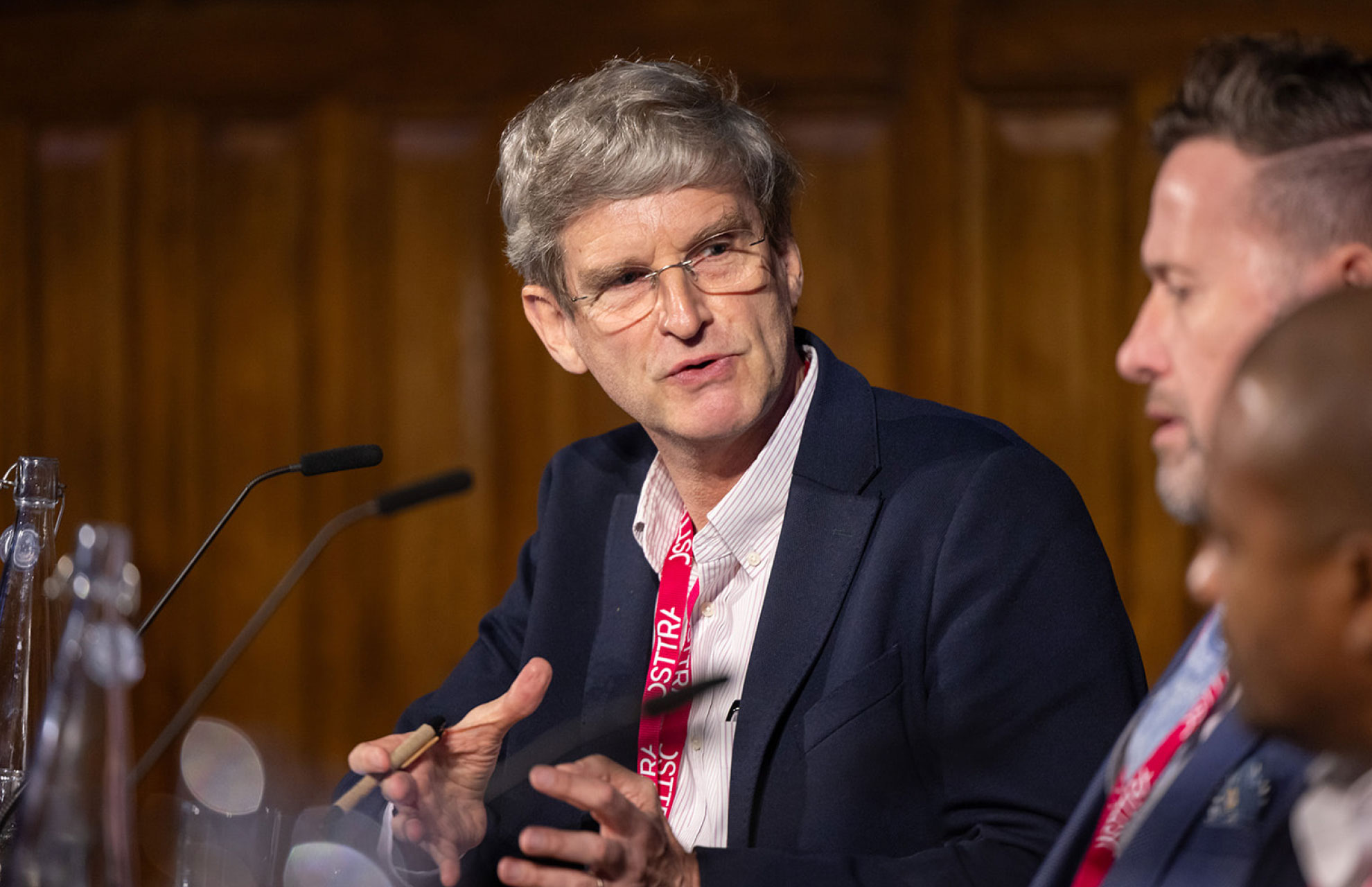 Image: Martin Walker
What are the implications of a world where trading is in a mix of digital and conventional securities? Do I need to throw away all my infrastructure and start again?
For much of the discussion around digital assets, there is an implicit assumption that moving financial assets onto distributed ledgers means moving the financial institution onto distributed ledgers too.
It is an appealingly simple proposition. Securities become tokens. Cash becomes tokenised. Transactions settle on a blockchain. Smart contracts automate transactions. Therefore, surely, the systems used to trade, manage risk, account for positions, and control settlement must also migrate onchain.
But does that logic really follow?
For banks, brokers, and asset managers contemplating a future containing both conventional and digital securities, the more useful question is not — how do we put our existing infrastructure on a blockchain?
It is: what actually changes when some of the assets our infrastructure manages happen to live on blockchains? That distinction matters.
Capital markets systems already live in a fragmented world
Consider what a conventional trading or post-trade system actually does.
A front-to-middle-office platform captures trades, maintains positions, calculates P&L and risk, and connects to execution and settlement infrastructure. Middle and back-office systems instruct movements of securities and cash, maintain books and records, generate accounting entries, and provide views of settled positions.
Crucially, these systems are already aggregators of information from multiple places.
A bond can be represented in a trading system without that system recreating the infrastructure on which legal ownership of the bond is ultimately recorded. Conventional systems primarily need to know what an asset is, where it is held, what has happened to it, and how to communicate with the infrastructure responsible for it.
Put differently, a system recording ownership of cows does not need a virtual model of the field in which the cows live. That rather mundane observation becomes important when the field is renamed ‘the blockchain’.
There isn’t one blockchain
The phrase ‘onchain’ can conceal rather more than it reveals.
There are public blockchains in which assets are controlled through centrally managed smart contracts, private networks governed by groups of participants, and private networks ultimately controlled by a single organisation.
So saying that an asset is onchain is a little like saying a conventional security is ‘held electronically’. Interesting, perhaps, but nowhere near enough information to operate a business.
Which chain? Which token? Who controls it? What rights does ownership convey? Is the token the authoritative ownership record, or does it represent an asset of which definitive ownership continues to reside on conventional infrastructure?
This last distinction is particularly important for tokenised real-world assets. In some structures, the blockchain record represents an asset while actual ownership continues to be recorded on conventional centralised infrastructure.
In other words, adding a ledger does not necessarily remove a ledger. Sometimes it adds another one.
Figure 1: Recording the number of cows rather than making a painting of each one distinguished ancient civilisations from cave men

Digital assets introduce new verbs
What does genuinely change is the operational vocabulary.
Traditional systems understand ideas such as buy, sell, deliver, receive, pledge, and redeem. Digital assets introduce additional concepts such as staking, locking into smart contracts, wrapping, minting, burning, airdrops, and atomic settlement.
Some have reasonably close conventional analogues. A token transfer resembles a securities delivery or payment. An airdrop can look somewhat like a scrip dividend. Depending on the asset, burning can resemble redemption. Atomic settlement on a single chain resembles gross delivery-versus-payment. Others are genuinely different.
A token might be staked and consequently unavailable for another purpose. Assets can be placed under the control of a smart contract.
A wrapped asset may represent an asset located on another blockchain. Crypto custody introduces management of private keys as an important part of controlling assets.
For an existing capital markets platform, however, the critical requirement is often surprisingly familiar: know what the asset is. Know where it is. Know whether it is available. Know how to move it. And know what happened after you tried.
That is an extension of the traditional operating model, not necessarily its destruction.
The future could actually be more fragmented
There is another uncomfortable possibility. Digital assets could initially make market infrastructure more complicated, not less.
Traditional capital markets already cope with multiple settlement venues, economically equivalent assets held in different locations, complex static data, and the difficulty of obtaining an accurate near-real-time view of inventory.
Distributed ledger technology does not automatically eliminate those problems.
The document notes that multiple blockchains do not have a universal interaction standard comparable to established financial messaging standards.
The same underlying asset can exist in different forms on different chains, potentially requiring minting and burning to produce the version a receiving party requires. Cross-chain transactions can also involve wrapped assets.
Instead of asking “is this an asset”, infrastructure increasingly needs to answer: which representation of this asset, on which infrastructure, under whose control, is available for this particular transaction?
That sounds revolutionary until you realise how closely it resembles a familiar securities-processing problem: identifying exactly where inventory is held and whether it is deliverable through the settlement route required by the counterparty.
The data model gets richer. Connectivity gets broader. Controls have to evolve. The fundamental problem does not disappear.
So do I need blockchain in my trading system?
Not necessarily. This is where architecture needs to be separated from fashion.
Many capital markets platforms do need modernisation. That does not establish that DLT is the appropriate technology for their internal P&L, risk, inventory, or accounting calculations. The source paper’s argument is that conventional technologies remain well suited to secure, high-volume processing for these purposes.
More importantly, the institution’s system still has to consolidate information across environments.
It may need positions from conventional custodians, CSDs, banks, crypto custodians, public networks, and private DLT networks.
Putting the aggregating system itself onto one blockchain does not magically make those other environments homogeneous.
The architectural objective should therefore be interoperability, rather than ideological purity. A system needs sufficient static data to identify different
The real transformation is at the boundary
This leads to what may be the more important technology conclusion. The biggest change may occur at the edges of existing systems, rather than at their centre.
A conventional platform does not necessarily need to become a blockchain platform. It needs to become blockchain-aware.
That means understanding new asset attributes and states. It means distinguishing different tokenised representations of economically similar assets. It means communicating with new places of settlement or with intermediaries that abstract that connectivity. And it means incorporating successful, failed, or reversed movements into the institution’s authoritative view of inventory. These requirements follow directly from the functions identified for existing systems and the additional DLT-related processes.
That architecture has an important strategic benefit too: it accepts that the future is unlikely to arrive in one clean migration.
Conventional securities are not going to disappear the morning somebody issues a tokenised bond. Institutions therefore have to operate conventional and digital assets simultaneously. Infrastructure capable of spanning both worlds may ultimately be more useful than infrastructure designed exclusively for either.
Figure 2
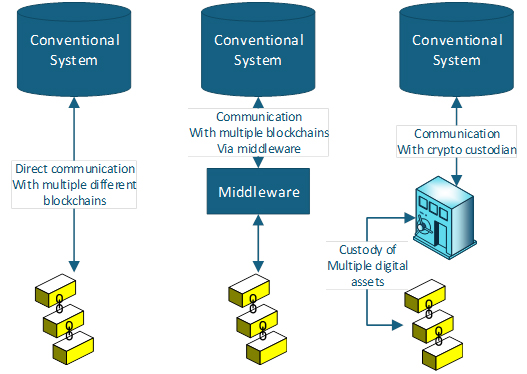
What happens on ledger stays on ledger. Except what matters
The seductive vision of blockchain is that everything can happen on a shared ledger and therefore enormous amounts of conventional market infrastructure can disappear. Parts of that vision may become reality.
But operating a financial institution requires a consolidated understanding of assets, liabilities, risk, P&L, collateral, and settlement, regardless of where the underlying record resides. Conventional capital markets systems already perform much of that aggregation across heterogeneous infrastructure.
Digital assets extend the number and nature of those infrastructures. The sensible response is therefore not to ask whether every existing system should be replaced with DLT.
It is to ask whether those systems can represent the new assets and states, connect securely to the environments in which they exist, initiate the necessary transactions and incorporate the results into an accurate enterprise view. Modernised systems with sufficient data models and connectivity to communicate with blockchains are a practical short-to-long-term requirement for capital markets firms dealing with digital assets.
So, do you need to throw away all your infrastructure and start again?
Probably not. But you may need to stop thinking of digital and conventional as two separate worlds. The winning infrastructure may not be the infrastructure that puts everything on a ledger. It may be the infrastructure that no longer cares which ledger an asset happens to be on.
For much of the discussion around digital assets, there is an implicit assumption that moving financial assets onto distributed ledgers means moving the financial institution onto distributed ledgers too.
It is an appealingly simple proposition. Securities become tokens. Cash becomes tokenised. Transactions settle on a blockchain. Smart contracts automate transactions. Therefore, surely, the systems used to trade, manage risk, account for positions, and control settlement must also migrate onchain.
But does that logic really follow?
For banks, brokers, and asset managers contemplating a future containing both conventional and digital securities, the more useful question is not — how do we put our existing infrastructure on a blockchain?
It is: what actually changes when some of the assets our infrastructure manages happen to live on blockchains? That distinction matters.
Capital markets systems already live in a fragmented world
Consider what a conventional trading or post-trade system actually does.
A front-to-middle-office platform captures trades, maintains positions, calculates P&L and risk, and connects to execution and settlement infrastructure. Middle and back-office systems instruct movements of securities and cash, maintain books and records, generate accounting entries, and provide views of settled positions.
Crucially, these systems are already aggregators of information from multiple places.
A bond can be represented in a trading system without that system recreating the infrastructure on which legal ownership of the bond is ultimately recorded. Conventional systems primarily need to know what an asset is, where it is held, what has happened to it, and how to communicate with the infrastructure responsible for it.
Put differently, a system recording ownership of cows does not need a virtual model of the field in which the cows live. That rather mundane observation becomes important when the field is renamed ‘the blockchain’.
There isn’t one blockchain
The phrase ‘onchain’ can conceal rather more than it reveals.
There are public blockchains in which assets are controlled through centrally managed smart contracts, private networks governed by groups of participants, and private networks ultimately controlled by a single organisation.
So saying that an asset is onchain is a little like saying a conventional security is ‘held electronically’. Interesting, perhaps, but nowhere near enough information to operate a business.
Which chain? Which token? Who controls it? What rights does ownership convey? Is the token the authoritative ownership record, or does it represent an asset of which definitive ownership continues to reside on conventional infrastructure?
This last distinction is particularly important for tokenised real-world assets. In some structures, the blockchain record represents an asset while actual ownership continues to be recorded on conventional centralised infrastructure.
In other words, adding a ledger does not necessarily remove a ledger. Sometimes it adds another one.
Figure 1: Recording the number of cows rather than making a painting of each one distinguished ancient civilisations from cave men
Digital assets introduce new verbs
What does genuinely change is the operational vocabulary.
Traditional systems understand ideas such as buy, sell, deliver, receive, pledge, and redeem. Digital assets introduce additional concepts such as staking, locking into smart contracts, wrapping, minting, burning, airdrops, and atomic settlement.
Some have reasonably close conventional analogues. A token transfer resembles a securities delivery or payment. An airdrop can look somewhat like a scrip dividend. Depending on the asset, burning can resemble redemption. Atomic settlement on a single chain resembles gross delivery-versus-payment. Others are genuinely different.
A token might be staked and consequently unavailable for another purpose. Assets can be placed under the control of a smart contract.
A wrapped asset may represent an asset located on another blockchain. Crypto custody introduces management of private keys as an important part of controlling assets.
For an existing capital markets platform, however, the critical requirement is often surprisingly familiar: know what the asset is. Know where it is. Know whether it is available. Know how to move it. And know what happened after you tried.
That is an extension of the traditional operating model, not necessarily its destruction.
The future could actually be more fragmented
There is another uncomfortable possibility. Digital assets could initially make market infrastructure more complicated, not less.
Traditional capital markets already cope with multiple settlement venues, economically equivalent assets held in different locations, complex static data, and the difficulty of obtaining an accurate near-real-time view of inventory.
Distributed ledger technology does not automatically eliminate those problems.
The document notes that multiple blockchains do not have a universal interaction standard comparable to established financial messaging standards.
The same underlying asset can exist in different forms on different chains, potentially requiring minting and burning to produce the version a receiving party requires. Cross-chain transactions can also involve wrapped assets.
Instead of asking “is this an asset”, infrastructure increasingly needs to answer: which representation of this asset, on which infrastructure, under whose control, is available for this particular transaction?
That sounds revolutionary until you realise how closely it resembles a familiar securities-processing problem: identifying exactly where inventory is held and whether it is deliverable through the settlement route required by the counterparty.
The data model gets richer. Connectivity gets broader. Controls have to evolve. The fundamental problem does not disappear.
So do I need blockchain in my trading system?
Not necessarily. This is where architecture needs to be separated from fashion.
Many capital markets platforms do need modernisation. That does not establish that DLT is the appropriate technology for their internal P&L, risk, inventory, or accounting calculations. The source paper’s argument is that conventional technologies remain well suited to secure, high-volume processing for these purposes.
More importantly, the institution’s system still has to consolidate information across environments.
It may need positions from conventional custodians, CSDs, banks, crypto custodians, public networks, and private DLT networks.
Putting the aggregating system itself onto one blockchain does not magically make those other environments homogeneous.
The architectural objective should therefore be interoperability, rather than ideological purity. A system needs sufficient static data to identify different
The real transformation is at the boundary
This leads to what may be the more important technology conclusion. The biggest change may occur at the edges of existing systems, rather than at their centre.
A conventional platform does not necessarily need to become a blockchain platform. It needs to become blockchain-aware.
That means understanding new asset attributes and states. It means distinguishing different tokenised representations of economically similar assets. It means communicating with new places of settlement or with intermediaries that abstract that connectivity. And it means incorporating successful, failed, or reversed movements into the institution’s authoritative view of inventory. These requirements follow directly from the functions identified for existing systems and the additional DLT-related processes.
That architecture has an important strategic benefit too: it accepts that the future is unlikely to arrive in one clean migration.
Conventional securities are not going to disappear the morning somebody issues a tokenised bond. Institutions therefore have to operate conventional and digital assets simultaneously. Infrastructure capable of spanning both worlds may ultimately be more useful than infrastructure designed exclusively for either.
Figure 2
What happens on ledger stays on ledger. Except what matters
The seductive vision of blockchain is that everything can happen on a shared ledger and therefore enormous amounts of conventional market infrastructure can disappear. Parts of that vision may become reality.
But operating a financial institution requires a consolidated understanding of assets, liabilities, risk, P&L, collateral, and settlement, regardless of where the underlying record resides. Conventional capital markets systems already perform much of that aggregation across heterogeneous infrastructure.
Digital assets extend the number and nature of those infrastructures. The sensible response is therefore not to ask whether every existing system should be replaced with DLT.
It is to ask whether those systems can represent the new assets and states, connect securely to the environments in which they exist, initiate the necessary transactions and incorporate the results into an accurate enterprise view. Modernised systems with sufficient data models and connectivity to communicate with blockchains are a practical short-to-long-term requirement for capital markets firms dealing with digital assets.
So, do you need to throw away all your infrastructure and start again?
Probably not. But you may need to stop thinking of digital and conventional as two separate worlds. The winning infrastructure may not be the infrastructure that puts everything on a ledger. It may be the infrastructure that no longer cares which ledger an asset happens to be on.
NO FEE, NO RISK
100% ON RETURNS If you invest in only one securities finance news source this year, make sure it is your free subscription to Securities Finance Times
100% ON RETURNS If you invest in only one securities finance news source this year, make sure it is your free subscription to Securities Finance Times